How Printer Ink Is Made – a Breakdown of Ingredients
Many people struggle with finding the right ink for their printers—whether it’s about getting vibrant colors, preventing smudges, or simply making sure their prints last. You’re not alone in wanting high-quality results without the hassle.
Printer ink is made by blending pigments or dyes with binders, solvents, and additives. Pigments provide color and opacity, while dyes create transparent, bright hues. Binders hold everything together and help ink stick, and solvents control flow and drying time.
Additives improve stability, water resistance, and durability. Different ink types and printing technologies require specific formulations. If you keep investigating, you’ll discover more about how these ingredients come together for quality prints.
Key Takeaways
- Printer ink is made up of pigments or dyes that give it color, along with binders or resins to help it stick and last.
- Solvents play a key role in controlling how the ink flows, dries, and spreads during printing.
- Additives are added to boost certain properties like stability, water resistance, gloss, and UV protection.
- The manufacturing process involves dispersing the pigments, mixing all the ingredients, and then testing the ink to ensure quality and consistency.
- Different types of printing require specific ink formulas. For example, inkjet inks need low viscosity, while UV-curable inks have special components.
What Are the Main Ingredients in Printer Ink?
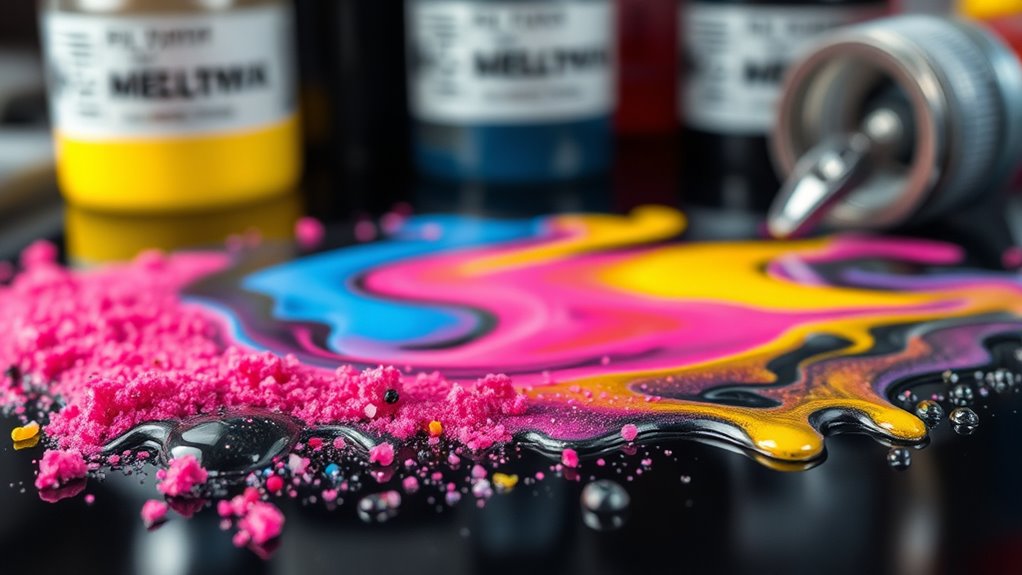
Printer ink is made up of several key ingredients that work together to produce vibrant and durable prints. The main components are pigments or dyes, which give the ink its color and vibrancy on paper.
Binders or resins help the ink stick to surfaces and form a tough, lasting film. Solvents, like water, alcohols, or hydrocarbons, dissolve the binders and enable smooth ink flow while helping it dry.
Additives such as dispersants and surfactants stabilize pigment particles and improve properties like flow and adhesion. Drying agents speed up evaporation, ensuring quick drying times.
All these ingredients are carefully combined in the ink formulation to optimize physical properties, making your prints vivid, durable, and consistent.
How Do Pigments and Dyes Create Color in Ink?
You can see that pigments and dyes are the key to creating color in ink, but they do it in different ways. Pigments stay suspended, providing opacity and vibrant hues. Dyes dissolve completely, producing bright and transparent colors.
How Pigments Provide Color
Pigments and dyes create color in ink through different mechanisms that influence the final appearance and durability of printed images. Pigments, as insoluble suspended particles, provide opaque, vibrant colors by remaining dispersed in the medium.
The color you see depends on their molecular structure, which determines hue by absorbing specific light wavelengths and reflecting others. Inorganic pigments like titanium dioxide and chromium green offer high stability and excellent lightfastness, ensuring long-lasting prints.
Particle size affects opacity and hue consistency. Smaller particles produce smoother, more uniform colors. Organic pigments often provide bright, vivid hues but may vary in lightfastness.
The overall color in ink results from the combination and concentration of these colorants, affecting the shade, intensity, and durability of your printed images.
How Dyes Dissolve in Ink
Dyes create color in ink by dissolving completely in the solvent, forming a transparent, uniform solution that produces vivid and consistent hues.
As water-soluble organic compounds, dyes easily penetrate paper fibers, ensuring sharp and vivid images or text. Their solubility depends on their chemical affinity for the ink’s solvent, like water or alcohol, which affects drying time and color intensity.
Because dyes dissolve thoroughly, they offer transparency and bright coloration, making them great for situations where vibrancy really matters. Unlike pigments, dyes tend to be less lightfast and water-resistant but excel at creating intense, penetrating colors.
Their solubility and molecular structure directly impact the ink’s transparency, color richness, and how well the ink interacts with the printing surface.
What Do Binders and Solvents Do in Ink Formulation?
Binders keep the pigment or dye particles together and help them stick to the printing surface. They’re basically the glue that holds everything in place.
Solvents dissolve or disperse the binders, which controls how smoothly the ink flows and dries. They play a key role in how easy the ink is to work with.
Together, binders and solvents determine the ink’s durability, appearance, and overall print quality. They’re essential for making sure the print looks great and lasts.
Role of Binders
Ever wondered how ink stays on paper without smudging or fading? The role of binders, resins, and polymers is key here. These materials act as film-forming agents, holding pigment or dye particles together and helping them stick firmly to the surface.
Binders create a coating that forms a durable, flexible layer. This boosts adhesion and prevents smudging. They also influence the ink’s stability, chemical resistance, and drying time, affecting how long the ink lasts and how quickly it sets.
In ink formulation, binders are dissolved or dispersed in solvents. This allows the ink to flow smoothly through nozzles. Their specific composition determines the final look, whether glossy or matte, and the overall durability of the printed image.
Function of Solvents
Have you ever wondered how ink flows smoothly from the printer nozzles onto paper? It’s all thanks to solvents, which serve three key functions in ink formulation.
First, they dissolve binders and ingredients, creating a uniform, flowable ink with the right viscosity for easy flowability.
Second, they control the evaporation rate, making sure the ink dries quickly once it hits the surface.
Finally, they influence stability and compatibility, helping the ink stay consistent and safe during use.
Which Additives Help Improve Ink Performance and Durability?
To improve ink performance and durability, manufacturers add various chemicals that boost stability and longevity. Dispersants and surfactants keep pigments evenly dispersed, preventing settling and clumping over time.
Rheology modifiers adjust viscosity, ensuring smooth application and reducing clogging or smudging. Drying agents promote faster, more uniform drying, which improves print quality.
Anti-oxidants and anti-aging agents protect the ink from chemical degradation, extending shelf life and maintaining performance. UV stabilizers guard against fading when exposed to sunlight, ensuring long-term image retention.
These additives are essential in ink formulation, working together to enhance stability, durability, and overall print quality. By carefully selecting these chemicals, manufacturers create inks that perform reliably across different conditions and applications.
How Are Different Types of Printer Ink Made? (Pigment-Based, Dye-Based, Specialty)
Different types of printer ink are made using different manufacturing processes, each suited to their chemical makeup and purpose.
Pigment-based inks involve dispersing tiny pigment particles into a liquid carrier, along with dispersants and binders to keep everything stable and durable. The process includes milling pigments to get them very fine and mixing them thoroughly with resins and solvents for an even spread.
Pigment inks use fine particles, dispersants, and binders for stability and durability.
Dye-based inks are made by dissolving soluble dyes into solvents, resulting in bright, transparent colors. They’re less resistant to water and light, but they produce vibrant images.
Specialty inks like UV or metallic types need unique chemicals and treatments. Examples include encapsulation or surface modifications to create specific visual effects or finishes. These processes show how important precise formulation is for each ink type’s purpose.
What Manufacturing Processes Are Used to Produce Printer Ink?
Manufacturing printer ink involves carefully blending various ingredients like pigments, dyes, binders, solvents, and additives in precise proportions to ensure consistent quality.
You start by dispersing pigments into varnish or resin bases using milling or grinding techniques for even color distribution. High-temperature mixing and homogenization then thoroughly combine all ingredients, preventing separation.
Additives such as stabilizers, drying agents, and surfactants are added to modify the ink’s physical and chemical properties. Throughout the process, quality control steps like testing viscosity, color accuracy, and stability are essential.
This precise process of dispersion, milling, and blending guarantees the final ink has a consistent texture, vibrant color, and reliable performance.
How Do Ink Components Affect Final Properties and Quality?
The specific ingredients in printer ink play a vital role in shaping its final properties and overall quality. Your choice of pigments influences opacity, color vibrancy, and resistance to fading. These factors directly impact print durability and visual appeal.
Printer ink ingredients determine color vibrancy, opacity, and durability, directly influencing print quality and longevity.
Binders determine adhesion, flexibility, and resistance to smudging or scratching. This affects the overall performance of the ink and how well it holds up over time. Solvents control flow, drying time, and spreadability, shaping how smoothly the ink applies and cures.
Additives modify physical properties like gloss, water resistance, and stability. They help ensure consistent quality under different conditions. The interaction among these components—pigments, binders, and solvents—ultimately defines the ink’s color accuracy, longevity, and performance.
When balanced correctly, these ingredients produce sharp, durable, and vibrant prints.
Why Do Ink Formulations Vary for Different Printing Technologies?
Printing technologies have different needs that shape how ink formulas are made. For example, inkjet inks need low viscosity so they can form tiny droplets accurately. Laser toners are made of fine powders with polymers that melt with heat and respond to static charges.
UV-curable inks rely on photoinitiators to quickly harden when exposed to UV light, making them perfect for digital printing. Solvent-based inks are designed to resist smudging and water damage, which makes them great for outdoor use.
Specialty inks, like metallic or glow-in-the-dark types, contain unique pigments and additives to create special visual effects. Here’s a quick look:
| Printing Tech | Ink Type | Key Ingredient/Feature |
|---|---|---|
| Inkjet | Liquid inks | Low viscosity, additives |
| Laser | Toner powders | Fused polymers, heat response |
| UV-curable | Photoinitiators | Rapid curing, unique properties |
| Solvent-based | Solvent carriers | Water resistance, durability |
| Specialty | Pigments/additives | Special visual effects |
Frequently Asked Questions
What Are the Ingredients in Printer Ink?
You find printer ink made of pigments or dyes that give it color and opacity. Solvents like water, alcohols, or hydrocarbons help dissolve binders and mix everything smoothly.
Binders such as resins make the ink stick to surfaces and form a durable layer. Additives like dispersants, surfactants, and stabilizers improve flow, prevent settling, and boost performance.
Inorganic pigments and organic dyes create a wide range of colors and effects.
Is Printer Ink Nontoxic?
Printer ink is generally non-toxic, especially the types used in homes and offices. You usually don’t need to worry about handling it, as it contains low levels of chemicals unlikely to cause harm through contact or inhalation.
However, some specialty inks like UV-curable or solvent-based ones can be hazardous. They require careful handling to stay safe.
Always follow safety guidelines, dispose of ink properly, and ensure good ventilation. This will help keep you safe when working with these inks.
What Are the Main Components of Printer Ink?
You’re asking about the main components of printer ink, and it’s a mix of essentials. Pigments or dyes provide the color, while binders help the ink stick to surfaces.
Solvents guarantee smooth flow through nozzles, and additives like dispersants and stabilizers keep everything stable and flowing.
Pigments offer opacity and durability, whereas dyes give vibrant hues but may fade faster. In short, these ingredients work together like clockwork to produce high-quality prints.
Why Is Printer Ink Not Vegan?
Printer ink isn’t vegan because it often contains animal-derived ingredients like shellac, bone char, or cochineal dye from insects. These substances are common in traditional ink production.
Many inks also involve chemicals tested on animals or processed using animal exploitation methods. Because of this, most commercial inks aren’t considered vegan.
If you want vegan options, look for inks labeled as cruelty-free or plant-based. However, many of these products don’t specify their ingredients, so it can be tricky to be sure.
Conclusion
Understanding how printer ink is made helps you appreciate the complexity behind each print. From selecting the right pigments and dyes to balancing binders and solvents, every ingredient plays a vital role.
Whether you’re printing documents, photos, or labels, quality depends on careful formulation and manufacturing. Knowing what goes into your ink can help you understand its performance, durability, and vibrant color.
This knowledge allows you to see how each component contributes to the overall quality. When you understand the ingredients, every print becomes a true reflection of your needs and expectations.