
Tracing the Origins of Pen Ink: A Step-by-Step Guide
Are you curious about where pen ink really comes from? You’re not alone—many people struggle to understand the fascinating history behind something as simple as a pen stroke. Whether you’re a writer, artist, or just someone who loves the story behind everyday objects, knowing the origins of pen ink can add a new layer of appreciation.
To trace the origins of pen ink, start by exploring ancient civilizations that used natural pigments like soot, charcoal, and plant residues for permanent writing. Learn how early chemists improved ink stability with innovations like lampblack, animal glue, and later synthetic formulas in the 19th century.
Uncover how key developments like iron gall ink shaped historic manuscripts and how modern technology continues to evolve ink for durability, security, and eco-friendliness. Continue exploring to uncover the full story behind ink’s fascinating history and future.
Key Takeaways
- Examine ancient ink artifacts and manuscripts to identify early materials like soot, plant residues, and natural pigments.
- Study historical records and archaeological findings to trace the development of ink-making techniques across civilizations.
- Analyze the chemical compositions of preserved inks to understand their origins and how technology evolved over time.
- Review advancements in ink formulations, such as the shift from natural to synthetic inks in the 19th century.
- Follow modern innovations, including nanotechnology and eco-friendly inks, to see how their origins have shaped current developments.
Where Did Ink Come From in Ancient Civilizations?
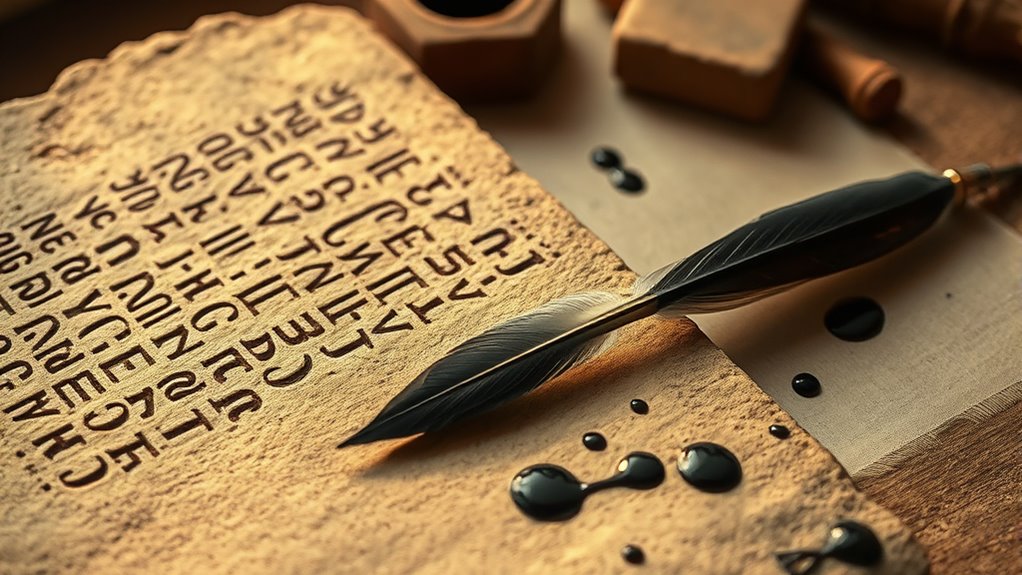
Ancient civilizations quickly realized they could make ink from natural materials like soot, charcoal, and plant residues. Carbon black, made from burning oils or resins, became important because it was durable and waterproof.
The Chinese, around 2697-2597 BC, mastered making ink from lampblack and animal glue. This created what we now call Chinese ink. Other civilizations also used soot mixed with gums to make their own inks for writing and drawing.
These early inks played a key role in recording history and ideas. They helped link the development of writing systems to the need for permanent records.
How Did Chemistry Improve Early Inks?
Advances in chemistry during the 18th and 19th centuries transformed how inks were made and refined. You can imagine a table illustrating this progress:
| Ingredient | Chemical Reaction |
|---|---|
| Tannin & gallic acid | React with iron salts to produce durable, dark iron gall ink |
| Pigments like alizarin | Improved color consistency and fastness |
| Analysis of degradation | Led to formulations resisting fading and discoloration |
| Modern techniques | Control viscosity, drying time, and water resistance |
This chemical understanding clarified how tannins, like gallic acid, reacted with iron salts, creating the iconic iron gall ink. Chemists also identified pigments to improve ink quality, making it more durable and resistant to time’s effects.
Why Was Iron Gall Ink the Standard in Medieval Manuscripts?
You’ll see that iron gall ink became the standard because it’s incredibly durable and long-lasting. Its deep, dark color makes text stand out clearly on parchment, ensuring readability for centuries.
This combination of strength and vividness made it the go-to choice for medieval manuscripts.
Durability and Longevity
The durability and longevity of iron gall ink made it the preferred choice for medieval manuscripts because it could last a long time without fading or falling apart. Its chemical makeup allowed it to bond tightly with parchment and paper, resisting smudging and decay.
The ink’s acidic nature ensured sharp, clear lines that stayed legible for centuries. This remarkable durability made iron gall ink essential for preserving important texts and documents across generations.
| Factor | Effect |
|---|---|
| Composition | Bonds chemically, resisting fading |
| Ingredients | Tannin-rich galls and iron salts |
| Adherence | Strongly sticks to writing surfaces |
| Resistance | Fades very slowly over time |
| Significance | Ensures long-lasting preservation |
Rich, Dark Color
Iron gall ink became the standard in medieval manuscripts mainly because of its deep, rich dark color that made the writing stand out on parchment.
This ink’s intense hue came from a chemical reaction between iron salts and tannins from galls, creating a stable compound that darkened over time.
Its deep, rich color made the writing highly visible and gave it an impressive look, especially for detailed scripts and illuminations.
The opacity improved readability, and the chemical reaction ensured the ink’s permanence.
Because of its vibrant appearance and durability, iron gall ink was preferred for important religious and scholarly texts.
Its ability to produce a durable, vividly dark mark helped cement its status as the go-to ink during the Middle Ages.
What Scientific Advances Transformed Ink Production in the 19th Century?
During the 19th century, scientific findings changed how ink was made by revealing the chemical properties that made inks more durable, stable, and resistant to aging. Researchers like Scheele and Deneur identified gallic acid and tannin through chemical analysis, which helped improve ink formulation.
Systematic studies by William Lewis and Ribaucourt refined the chemistry behind ink durability, leading to inks that lasted longer. August Leonardi’s 1855 alizarin ink introduced the first modern iron gall ink, offering better resistance to aging.
Industry efforts by France and Prussia focused on creating inks that resisted aging and forgery. Advances in chemical analysis and testing methods helped standardize production, ensuring consistent quality.
This table summarizes key developments:
| Key Figure | Chemical Discovery | Impact on Ink Production |
|---|---|---|
| Scheele | Gallic acid | Improved ink stability |
| Deneur | Tannin | Enhanced durability |
| Leonardi | Alizarin | Resistance to aging |
How Did Modern Inks Like Alizarin and Aniline Change the Industry?
The introduction of alizarin and aniline inks brought major changes to the ink industry through chemical innovations. These synthetic dyes provided brighter colors and were more durable, which made inks more reliable for different uses.
As a result, the industry experienced rapid growth. There was a shift toward chemically stable, consistent products that replaced traditional pigments. This transformation helped modernize ink production and broaden its applications.
Chemical Innovations and Discoveries
Chemical innovations like alizarin and aniline transformed ink manufacturing by introducing stable, vibrant, and fast-drying dyes that revolutionized the industry. The development of alizarin ink in 1855 marked a major breakthrough, providing a chemically stabilized version of traditional iron gall ink with improved durability and color intensity.
Around 1865, aniline dyes emerged, creating synthetic inks with vivid hues and quick drying times. These advancements greatly enhanced efficiency and image quality. They also boosted resistance to fading, forgery, and chemical degradation.
The table below summarizes key milestones:
| Year | Innovation | Impact |
|---|---|---|
| 18th c. | Gallic acid & tannin | Clarified iron gall ink chemistry |
| 1855 | Alizarin ink | Modern, stabilized iron gall ink |
| 1865 | Aniline dyes | Vibrant, fast-drying synthetic inks |
Industry Transformation and Growth
Modern inks like alizarin and aniline transformed the industry by shifting production from handcrafted methods to scientifically optimized, mass-produced processes. The development of alizarin ink in 1855 marked the rise of modern iron gall inks, offering improved durability and colorfastness.
Around 1865, aniline dyes introduced vibrant, synthetic hues, transforming ink diversity and intensity. These breakthroughs led to the widespread adoption of chemical-based inks, fueling industry change.
As a result, printing became faster, more reliable, and accessible, moving beyond handwritten manuscripts. Concerns about ink longevity, forgery, and document security also grew with these innovations, prompting further advancements.
- Shift from handmade to mass production
- Introduction of vibrant synthetic colors
- Rise of chemical-based inks
- Improve durability and security
- Move to printed documents
What Are the Most Popular Types of Ink Used Today?
Today, a variety of ink types dominate different writing and artistic applications, each chosen for their specific properties. Fountain pen inks, often water-based, are popular for their smooth flow and vibrant colors.
Waterproof inks like India ink and pigment inks are favored for their durability. They resist water and fading over time, making them great for long-lasting projects.
Pigmented inks contain tiny particles and are used for both artistic and archival purposes. They ensure longevity and vibrant results.
Gel inks and hybrid inks combine dye and pigment qualities, offering smooth writing and high color intensity.
Eco-friendly and vegan inks, such as Octopus Write & Draw, are gaining popularity. They are non-toxic and have high pigment content, making them a good choice for conscious consumers.
These diverse options cater to different needs, from everyday writing to long-lasting artwork.
What New Technologies Will Shape the Future of Ink?
Emerging technologies are transforming the future of ink, offering new possibilities for durability, functionality, and sustainability. Advances in nanotechnology create ultra-fine pigment particles, boosting ink vibrancy and longevity, which is perfect for fountain pens.
Smart inks with conductive properties are enabling innovations in electronic and wearable devices, making your writing or displays more interactive. Biodegradable and plant-based inks are being developed to reduce environmental impact, aligning with eco-friendly practices.
AI-driven formulation allows for precise customization tailored to specific artistic and industrial needs, enhancing performance. Innovations like microencapsulation improve control over ink release, optimizing printing and writing.
These technologies are shaping a future where ink becomes more durable, adaptable, and sustainable.
Summary: The Evolution and Future of Ink
The evolution of ink reflects a long history of innovation, moving from simple soot and natural pigments to complex, scientifically formulated inks that meet modern demands for durability, security, and environmental responsibility.
Throughout the history of ink, advancements like iron gall ink in the Middle Ages and synthetic inks in the 19th century have greatly improved longevity and resistance. Scientific research has driven innovations in stability, colorfastness, and anti-forgery features, shaping its development.
Advancements like iron gall and synthetic inks have significantly enhanced ink’s durability and resistance over history.
Today, the future of ink focuses on creating environmentally sustainable formulations, high-performance artistic inks, and security inks for official documents. Ongoing technological progress guarantees that ink remains relevant and adaptable.
It continues to bridge traditional methods with the digital age, paving the way for continued innovation in this essential medium.
Frequently Asked Questions
Where Did Pen Ink Originally Come From?
You find that pen ink originally came from soot and carbon black, used in ancient Egypt and China around 3000 BCE. These early inks were made by burning organic materials like resin or bones to produce fine black soot.
Chinese ink, called India ink, combined soot with gum arabic, while Egyptian scribes used similar soot-based inks on papyrus. These ancient sources laid the groundwork for more advanced ink formulas later on.
How Is Pen Ink Made Step by Step?
Think of making pen ink like brewing a secret potion. You start by selecting vibrant pigments or organic dyes, then grind or dissolve them in a liquid binder, like water or oil.
You mix thoroughly, filtering out impurities to keep it smooth. Add stabilizers or preservatives to protect your potion from spoilage.
Finally, blend everything into a consistent, flowable ink ready to bring your ideas to life on paper.
What Is the Origin of Pen and Ink?
You’re curious about the origin of pen and ink. It all began in ancient civilizations like China and Egypt around 3000 BCE, where they first created soot-based inks using natural materials like lampblack soot and gum arabic.
These early inks went hand-in-hand with the development of writing tools such as reed pens, quills, and metal nibs. Over time, the use of ink spread across different cultures.
It played a big role in shaping how humans record history and communicate.
Where Does the Ink From a Pen Come From?
Like the black smoke from a chimney’s darkened dawn, the ink in your pen comes from natural pigments such as soot, charcoal, or plant dyes. You’re drawing with a liquid crafted by mixing these pigments with water and binding agents like gum arabic.
Modern inks may add synthetic dyes, but they all share a careful chemical blend designed to flow smoothly, stick firmly, and resist fading over time.
Conclusion
As you trace ink’s fascinating journey from ancient scribes to modern chemists, you realize how each breakthrough, like the invention of iron gall or synthetic dyes, transformed communication.
Curiously, some believe that the earliest inks were inspired by natural phenomena like animal secretions. Today, emerging technologies promise even more innovative inks that will shape your future writings.
So, next time you pick up a pen, remember—you’re part of a centuries-old story of discovery and creativity rooted in the history of pen ink.