Does a Laser Printer Use Ink?
Printing can be tricky, especially if you’re unsure about the type of printer you need or how it works. Many people struggle with understanding whether laser printers use ink or something else. If you’re considering a printer for your home or office, knowing the basics can save you time and money.
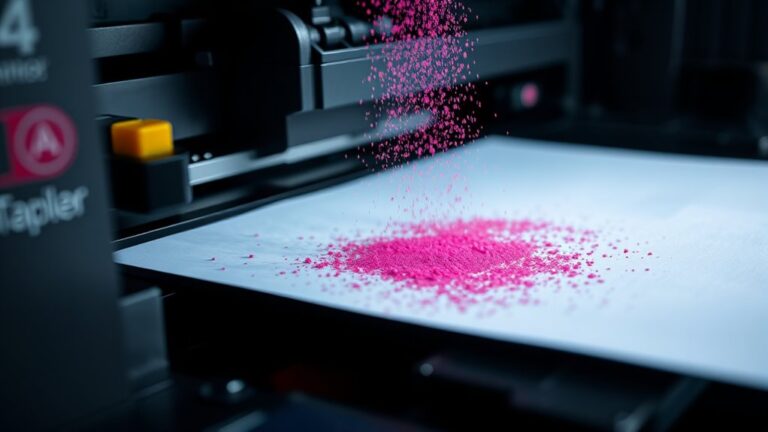
No, a laser printer doesn’t use ink. Instead, it uses dry toner powder made of plastic particles and pigments.
When you print, the laser beam targets a photosensitive drum, which attracts the toner in the pattern of your document. The toner then transfers onto paper and is fused with heat.
If you want to understand more about how laser printers work and their advantages, keep exploring how toner differs from ink.
Key Takeaways
- No, laser printers don’t use liquid ink; they use dry toner powder instead.
- They create images by fusing toner to paper with heat and pressure.
- Toner is a plastic-based powder, not a liquid like traditional ink.
- Laser printers are designed to produce dry, sharp, and durable prints without worrying about ink drying issues.
- They rely on electrostatic and thermal processes, not ink-based liquid technology.
How Do Laser Printers Make Images Without Using Ink?
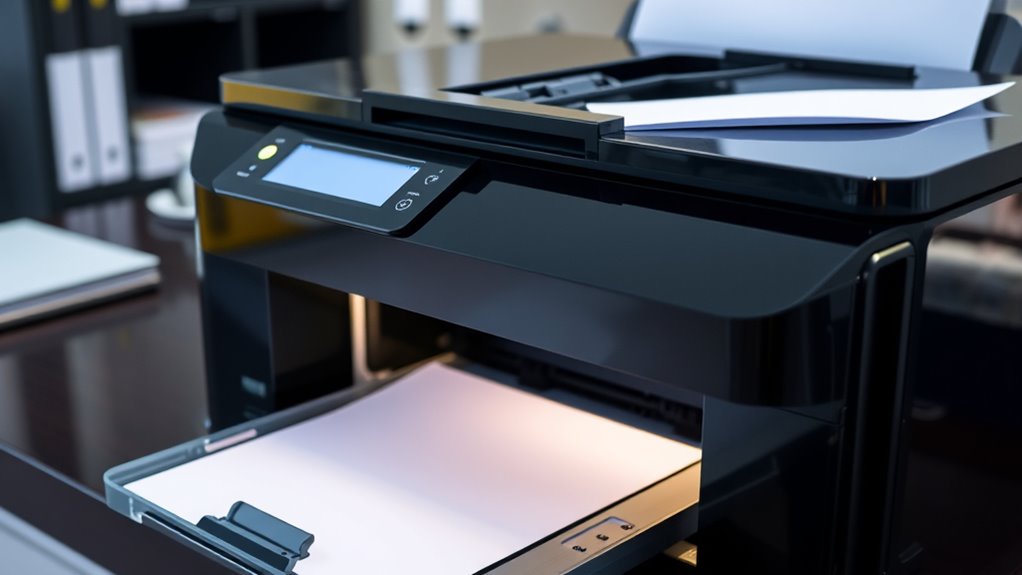
Laser printers create images without ink by using a dry toner powder instead. Inside, a laser sends a focused beam onto a photosensitive drum, charging specific areas with electrostatic charges.
These charged regions attract toner particles, which form the desired images or text. The toner, a fine powder, sticks to the drum in the pattern of the image.
During printing, the toner is transferred from the drum onto paper. Heat and pressure then fuse the toner permanently to the paper, producing high-quality, sharp images.
Unlike inkjet printers, laser printers don’t rely on liquid ink droplets. Instead, they use electrostatic charges and heat to create clean, precise, inkless prints.
This process guarantees fast, efficient, and professional results every time.
What Is Laser Toner, and How Is It Different From Ink?
Laser toner is a dry powder made of plastic particles and pigments, fused onto paper with heat and pressure. Unlike liquid ink in inkjet printers, toner produces sharper images and lasts longer without drying out or clogging. Understanding these differences helps you see why laser printers are often more cost-effective for high-volume printing.
Composition and Material Differences
Unlike liquid ink used in traditional printers, toner is a dry powder that contains plastic particles, pigments, and chemicals. Its composition keeps it stable inside a cartridge until it’s needed.
The materials in toner are designed for fusion; during printing, heat and pressure melt the powder, bonding it to paper for a durable, smudge-resistant finish. In contrast, ink is a liquid dispensed through nozzles, with dyes or pigments suspended in liquid.
Fine toner particles, usually 5 to 15 microns, allow for precise printing with sharp detail. While ink can dry out or smudge easily, toner’s powder form stays stable, making it ideal for high-quality, long-lasting prints in laser printers.
Application and Usage Variations
While both laser printers and inkjet printers produce printed images and text, their application methods and materials differ greatly. Laser printers use toner, a dry powder made of plastic particles, instead of liquid ink. During printing, the laser beam charges areas of a drum, attracting toner particles that are then transferred and fused onto paper with heat.
This process results in sharper, more durable prints, especially for high-volume jobs. In contrast, inkjet printers rely on liquid ink sprayed onto paper, which can smudge or dry slowly. Toner cartridges in laser printers generally have a higher page yield and longer shelf life, making them more suited for professional-quality printing.
These differences impact print quality, speed, and how often each type of printer is used.
Cost and Maintenance Factors
Toner, the dry powder used in laser printers, is quite different from liquid ink when it comes to cost and maintenance. While toner cartridges cost more upfront, they produce more pages and last longer, making them cheaper for heavy printing.
Compared to ink cartridges, toner needs to be replaced less often, which means less time and money spent on maintenance. Laser printers also tend to print faster, and their quality stays high even after many pages.
Fusing toner to paper uses heat and pressure, so there’s less mess and drying time than with ink. Overall, using toner is more cost-effective over the long run because of fewer replacements and its durability, especially if you print often.
Can Laser Printers Print on Different Types of Media?
Have you ever wondered if your laser printer can handle more than just standard paper? The answer is yes. Laser printers use toner, not ink, and are quite versatile with different media types.
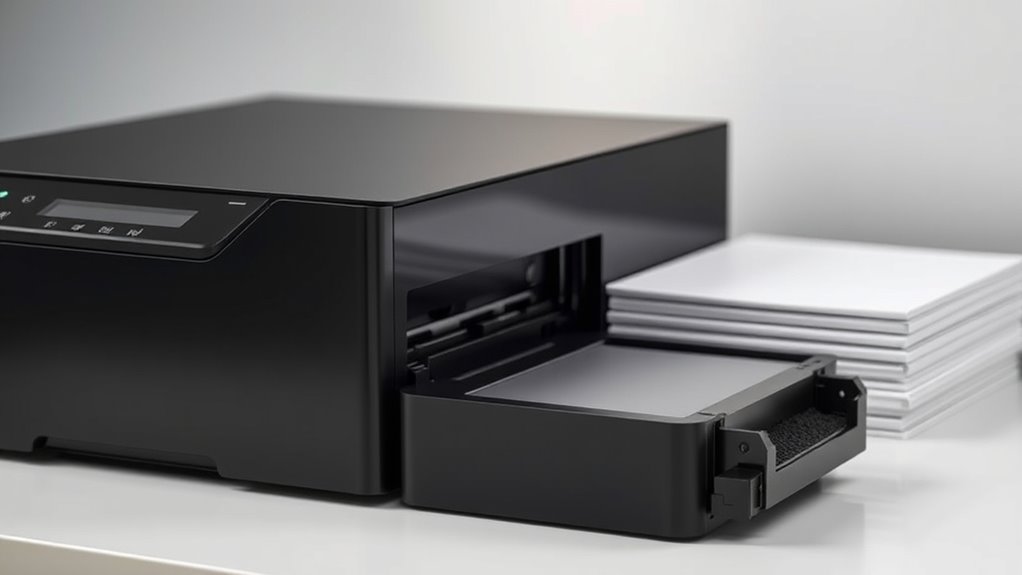
They can print on various printing media, including cardstock, transparencies, and specialty papers. Thanks to their media handling and trays, they support media with different thicknesses and textures, so you can print on different surfaces.
However, media compatibility depends on the printer model. Some may need specific settings or compatible trays to avoid jams or damage.
Media flexibility is important for printing on envelopes, labels, and even heat-fusable fabrics. Overall, laser printers offer broad media options, letting you expand your printing projects beyond just standard paper.
How Does the Fusing Process Work in Laser Printing?
After your laser printer processes the digital image or document, the next step is to secure the print onto the paper through the fusing process. In this stage, the toner, a dry powder, is melted and bonded to the paper surface by the fuser assembly, which uses heat and pressure.
The heated rollers soften the toner particles, allowing them to spread and adhere firmly to the paper fibers. Precise temperature control in the fuser guarantees the toner melts properly without damaging the paper or causing jams.
The pressure applied helps press the toner into the paper, creating a durable, smudge-resistant image. This fusing process ensures your prints are sharp, vibrant, long-lasting, and resistant to handling.
What Are the Benefits of Using Toner Instead of Ink?
Using toner in laser printers offers several advantages over liquid ink. First, toner produces sharper, more durable images, making the print quality better.
Toner in laser printers delivers sharper images and longer-lasting print quality.
Second, it’s highly cost-efficient, especially for high-volume printing, thanks to higher page yields per cartridge.
Third, toner prints are smudge-proof and resistant to fading, which means your prints last longer.
Fourth, toner doesn’t dry out or clog like ink, so there’s less maintenance and less downtime.
Furthermore, toner allows for faster print speeds and keeps a consistent quality over time.
This makes laser printers perfect for busy environments that need reliable, high-quality output.
Are Laser Printer Prints as Good as Inkjet Photos?
Are laser printers suitable for producing high-quality photos? Generally, no. Laser printers are great for sharp text and graphics but aren’t ideal for photo printing.
They tend to produce images with less accurate colors, limited subtle color variations, and lower resolution, which can make photos look less smooth and a bit pixelated.
Inkjet printers are much better for photos because they handle fine details and vibrant colors more effectively.
If you want images with rich color blending and true-to-life quality, inkjet printers are the way to go.
Laser printers focus on crisp text and graphics, not nuanced photo details, so for professional or high-quality photo printing, inkjets deliver better results and more realistic images.
Frequently Asked Questions
What Are the Disadvantages of a Laser Printer?
Laser printers have some disadvantages. They cost more upfront, and their bulky size takes up more space. The toner cartridges are expensive and need replacing frequently, which adds to ongoing costs.
They’re less flexible for printing on specialty media like photo paper or fabric. Plus, laser printers can be noisy, and their maintenance might be more complicated compared to smaller, more portable printers.
Do Laser Printers Require Ink Refills?
Laser printers don’t need ink refills because they use toner powder instead of liquid ink. When the toner runs out, you usually just replace the whole cartridge instead of trying to refill it yourself.
There are refill kits available, but most people prefer buying new cartridges for the best quality and reliability. You can’t just add toner like ink, so keeping an eye on toner levels means replacing cartridges when needed.
Which Is Better, Laser or Inkjet?
Choosing between laser and inkjet depends on your needs. If you prioritize speed, cost-efficiency, and high-volume printing of text, a laser printer is better.
But if you want vibrant color photos and detailed images, an inkjet printer suits you more. Think about what kind of printing you do most, your budget, and the quality you need.
That way, you can pick the one that fits your style best.
Why Are Laser Printers Being Phased Out?
You might say, “out with the old, in with the new,” and that’s exactly why laser printers are being phased out. They’re costly upfront, and toner cartridges are expensive, which makes them less ideal for small businesses or homes.
Advances in inkjet technology now offer high-quality color printing at lower costs. Plus, environmental concerns about energy use and waste are pushing laser printers further into obsolescence.
Mobile and cloud printing options also make laser printers less necessary than ever before.
Conclusion
In the world of printing, laser printers deliver sharpness, speed, and durability, making your documents stand out. They fuse toner onto paper, creating images that are crisp, resilient, and professional.
Unlike inkjet printers, laser printers do not use ink. Instead, they rely on toner, a fine powder, to produce high-quality prints quickly and efficiently.
Whether you’re printing on different media or seeking efficiency, laser printers provide reliability, consistency, and top-notch quality. Welcoming the power of toner, harnessing the speed of laser, and enjoying the clarity that transforms your everyday printing into a seamless, satisfying experience.