What Mechanism Do Squids Use to Produce Ink?
Are you curious about how animals like squids defend themselves so effectively? Many people struggle to understand the fascinating mechanisms behind nature’s defense systems.
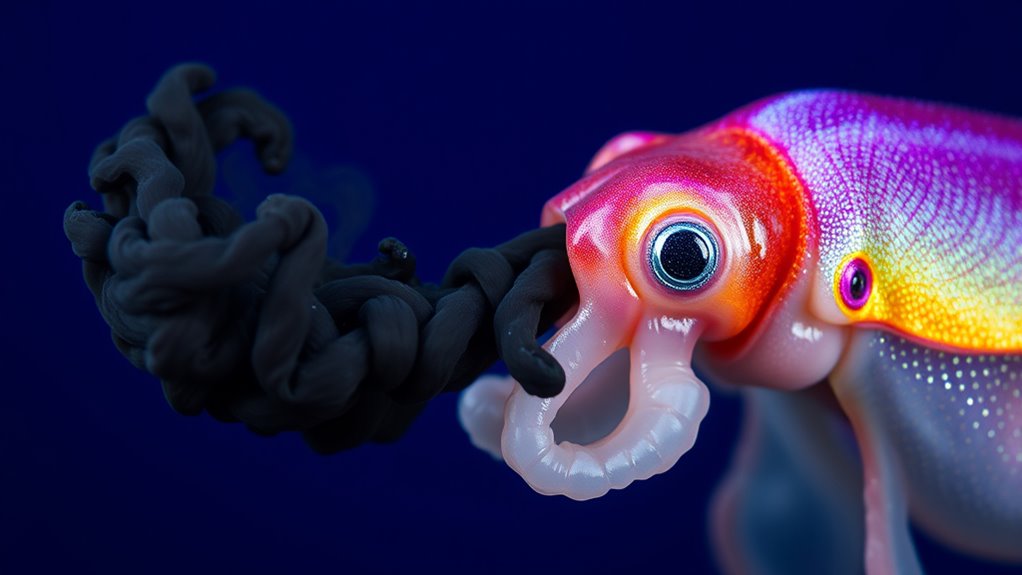
Squids produce ink in a specialized gland called the ink sac, where they store a mixture of melanin, mucus, amino acids, and metals. When threatened, muscles contract around the sac, pushing the ink through the siphon and rapidly ejecting it to form a cloud in the water.
This ink cloud acts as a smokescreen or decoy, helping the squid escape predators.
To uncover more about how this fascinating process works, keep exploring the details behind their ink production.
Key Takeaways
- Ink is made in the ink sac, which is a gland located near the squid’s digestive system. This sac holds a mixture of pigment and chemicals ready for use.
- Epithelial cells in the ink sac produce melanin, mucus, and amino acids. These are the key ingredients that make up the ink.
- Muscles around the ink sac contract, pushing the ink out through the siphon. This action happens quickly, allowing the squid to eject ink rapidly.
- The ink is released as a dense cloud, creating a smokescreen or decoy. This helps the squid escape from predators.
- The shape and size of the ink cloud can change depending on what the squid is doing and the environment.
How Do Squids Produce Ink? An Overview of the Process
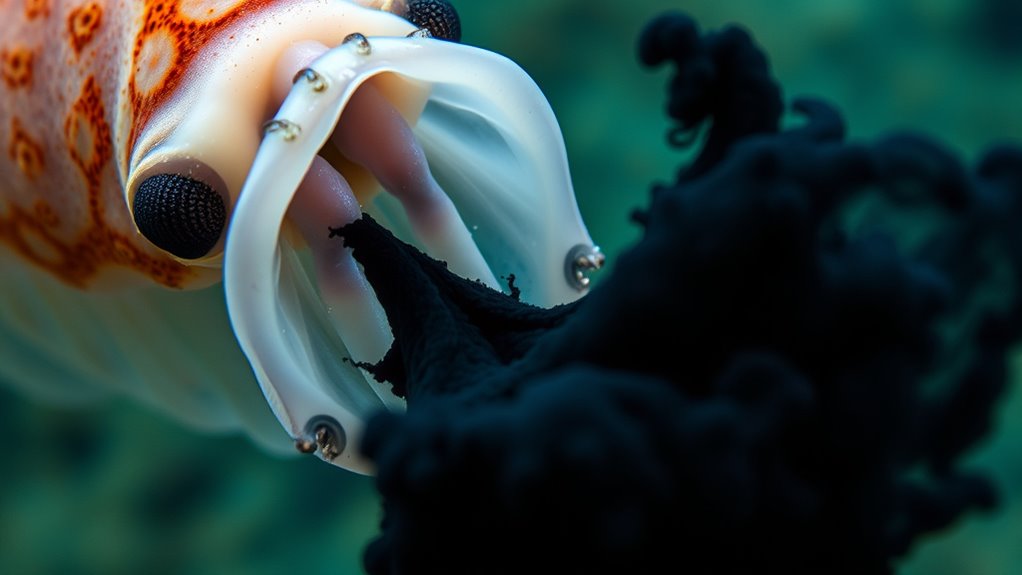
Ever wonder how squids produce their ink? It all starts with the ink sac, a special gland near their digestive system. Inside, the ink is stored as a mix of melanin, mucus, amino acids, and other chemicals.
When threatened, the squid contracts muscles around the ink sac, pushing the ink through a siphon. As it ejects, the ink forms a dense cloud in the water, acting as a smokescreen or decoy.
This ink cloud is made up of tiny particles, usually 80–150 nm, which help hide the predator’s view. The mixture’s amino acids and other substances make it dark and thick, giving the squid control over how it’s released and shaped during escape.
What Is the Anatomy of the Squid Ink Sac?
The squid ink sac is a special internal gland located near the digestive system. It acts as a storage tank for ink until the squid needs it for defense.
This ink sac is made up of epithelial cells that produce melanin, mucus, and amino acids, which are all essential for forming ink. When threatened, the musculature of the sac helps expel the ink quickly and in a controlled way.
The ink is stored as a polydisperse suspension within the sac, with particles ranging from 80 to 150 nanometers. The sac connects to the cloaca through a duct, allowing the ink to be expelled through the funnel during defense.
This anatomy allows squids to release ink rapidly, helping them escape predators effectively.
What Are the Chemical Components of Squid Ink?
Squid ink is a complex mix of chemicals that create its dark color and unique properties. It mainly contains melanin, which gives it its deep black hue.
Along with melanin, it has mucus, amino acids, and trace metals. These components influence the ink’s density and color.
Understanding these parts helps us see how squids produce such effective defense ink.
Melanin and Mucus Composition
At the heart of squid ink’s dark hue is melanin, a pigment that absorbs light and gives the ink its characteristic color. This melanin is made through enzymes like tyrosinase and dopamine, which help produce it inside the ink sac.
Alongside melanin, mucus plays a key role in keeping the ink particles suspended. It contains glycoproteins that help disperse and stabilize the ink, ensuring it flows smoothly.
The chemical makeup also includes amino acids such as taurine, aspartic acid, glutamic acid, alanine, and lysine. These support cell functions and add to the ink’s biological properties.
Metals like iron and trace elements are present too, influencing the ink’s density and physical traits. All these components work together to give squid ink its unique color, texture, and biological functions.
Chemical Agents and Amino Acids
Chemical agents like tyrosinase and dopamine are key in producing melanin, the pigment responsible for the ink’s dark color. Tyrosinase helps convert amino acids into melanin, giving the ink its rich hue.
Besides melanin, squid ink contains amino acids like taurine, aspartic acid, glutamic acid, alanine, and lysine. These amino acids influence its viscosity and how it reacts chemically during defense.
They help regulate the ink’s properties, making it more effective in escape mechanisms. The table below highlights some of the main components:
| Chemical Agent | Function | Effect on Ink |
|---|---|---|
| Tyrosinase | Melanin production catalyst | Darkens ink color |
| Dopamine | Regulates melanin synthesis | Stabilizes pigmentation |
| Amino Acids | Chemical interactions | Viscosity and durability |
This combination makes squid ink a complex and adaptive defense tool.
Metal Content and Variability
Have you ever wondered what gives squid ink its distinctive density and color? The answer lies in its metal content and chemical variability.
Metals like iron, copper, and zinc are present in the ink and influence its properties. For example, in *Sepia officinalis*, metals make up about 4.7%, helping keep the particles dense and suspended.
The chemical variability among squid species affects the ink’s color, viscosity, and how well it works as a defense. Metal ions help keep particles, which range from 80 to 150 nanometers, evenly suspended.
This variability in chemistry is key to the ink’s function and appearance.
How Do Muscles Contract to Eject Ink?
When a squid needs to eject ink quickly, the muscles around the ink sac contract to create pressure. This contraction reduces the sac’s volume, forcing ink into the siphon.
From there, the ink is expelled rapidly through the siphon, forming a jet or cloud to distract predators. The muscles involved are smooth muscle fibers that work together for a swift, forceful ejection.
Ink is rapidly expelled through the siphon, creating a cloud to distract predators.
Neural signals trigger these contractions, allowing the squid to react instantly when threatened. Think of this process like a small but powerful pump:
| Muscle fibers contract | Pressure builds | Ink is expelled |
|---|---|---|
| Siphon opens | Ink escapes | Predator is distracted |
| Rapid response | Inks ejected | Defense mechanism activated |
How Do the Funnel and Siphon Help Squids Spray Ink?
The funnel, or siphon, plays a key role in how squids spray ink by acting as a flexible tube that directs the ink cloud toward a threat. When you’re threatened, you contract muscles around the ink sac, increasing pressure to force ink out through the siphon.
The siphon’s ability to pivot allows you to aim the ink precisely, creating a dense cloud that helps you escape. This targeted spray is really effective for confusing or distracting predators.
- The siphon directs the ink ejection toward the predator
- Its flexible orientation lets you aim quickly and accurately
- When combined with jet propulsion, it boosts your escape tactics
Why Do Squids Eject Ink? The Purpose Behind the Defense
When a predator gets too close, you might notice a squid eject ink to create a cloud that confuses and distracts. This ink acts as both a visual smokescreen and a chemical signal, helping the squid escape.
Its purpose is simple: it increases the squid’s chances of survival during an attack.
Predator Distraction Tactics
Squids eject ink as a quick defense to disorient predators and give themselves a chance to escape. The ink creates a visual and chemical barrier that confuses the predator, making it harder to focus.
When threatened, you’ll see the squid shoot out a dense cloud through its siphon, often forming shapes like pseudomorphs or ropes that mimic its body. This ink cloud acts as a distraction, blocking the predator’s line of sight and overwhelming its senses.
The ink cloud confuses predators by hiding the squid’s location. It also messes with their ability to track or target accurately. Essentially, the ink is an immediate distraction that helps the squid slip away unnoticed.
Camouflage and Escape
Ejecting ink is a key escape tactic, helping squids vanish from predators quickly. When threatened, you release a cloud of ink from special glands, creating a visual and chemical distraction.
This ink cloud can form pseudomorphs—mimicking your shape—to confuse predators even more. As you jet away, the ink acts like a smokescreen, reducing visibility and giving you a better chance to escape.
Plus, the ink serves as a chemical signal, overwhelming predator senses and warning nearby squids of danger.
| Ink Composition | Function |
|---|---|
| Melanin | Creates a dark, visible cloud |
| Mucus | Thickens ink for pseudomorphs |
| Amino acids | Boosts chemical signaling |
| Ink sac | Stores and expels ink |
| Camouflage | Provides visual distraction for escape |
Chemical Signaling Roles
The primary purpose of ink ejection is to serve as a chemical signal that deters predators and warns nearby squids of danger. This signaling depends on the ink’s composition, which includes compounds like tyrosinase that can irritate or deactivate predator chemosensory systems.
When squids release ink, it overwhelms predators’ scent receptors, especially in sharks, giving them a chemical defense. It also acts as a warning to other squids, alerting them to potential threats.
The ink’s chemical signaling confuses predators and makes it harder for them to succeed in attacking. Its composition boosts this effect by irritating chemosensory organs.
What Variations Are There in Ink Production Among Squid Species?
Different squid species show a wide variety in their ink production, shaped by their unique adaptations and environments.
The composition and pigmentation of their ink differ, influencing color and density. Some squids produce traditional black or bluish ink, while others create colored or iridescent versions.
Certain species have special organs that produce luminous ink through bioluminescence, creating glowing clouds for defense.
The size and structure of ink sacs vary, affecting how much ink they can eject and how they release it.
Additionally, the presence of metals and amino acids in the ink changes its viscosity and chemical properties.
These differences help squids customize their ink defenses, improving their chances of survival in various habitats and against different predators.
What Shapes and Forms Does Ink Take During Ejection?
When a squid releases its ink, the shapes and forms it takes are quite adaptable, influenced by the animal’s behavior and environment. You might notice different ink shapes such as:
- Ink clouds: big, diffuse suspensions that hide the squid’s movement, acting like smoke screens.
- Pseudomorphs: ink structures expelled with mucus that mimic the squid’s shape, confusing predators.
- Ink ropes: long strands that help the squid hide among the ink, giving it a visual escape route.
The specific shape of the ink depends on how the squid is inking and what’s around it. This makes the ink versatile for quick camouflage or distraction. These different forms help the squid defend itself in various threats and environments.
How Does the Ink Cloud Help Squids Escape Predators?
When a squid releases ink, it creates a dark, dense cloud that blocks the predator’s view and confuses its sense of smell.
This sudden distraction gives the squid a vital moment to escape before the predator can track it down.
The ink cloud acts like a smokescreen, increasing the squid’s chances of survival during a quick getaway.
Obscures Predator Vision
The ink cloud helps squids escape predators by creating a visual barrier that confuses and distracts them. This visual obstruction blocks the predator’s line of sight, making it harder to track the squid’s movements.
As the ink disperses rapidly in water, it forms a dense, opaque screen filled with dark melanin, which absorbs and scatters light effectively. This sudden cloud can:
- Create predator confusion by disrupting their focus
- Serve as a quick visual obstacle, delaying pursuit
- Maximize disorientation when combined with rapid jet propulsion
Confuses Scent Trails
As the ink cloud spreads through the water, it does more than just block the predator’s view. It also creates a chemical barrier that masks the squid’s scent trail. This ink contains compounds like tyrosinase and amino acids, which interfere with the predator’s chemosensory detection, causing chemosensory disruption.
The dense, polydisperse ink suspension quickly disperses and dilutes the squid’s scent signature. This confuses the predator about its location. The chemical barrier overwhelms olfactory receptors, making it hard to follow scent cues or visually find the squid.
The table below summarizes how the ink cloud disrupts scent tracking:
| Effect | Description |
|---|---|
| Chemical barrier | Masks scent trail with compounds |
| Dispersal | Dilutes and disperses in water |
| Chemosensory disruption | Overwhelms olfactory receptors |
| Predator confusion | Hampers scent and visual cues |
Promotes Sudden Escape
Squids rely on their ink cloud to make a quick and effective escape from predators. When threatened, they release a dense ink cloud, creating a visual and chemical smoke screen that hampers the predator’s view.
This ink cloud often contains pseudomorphs and ropes that mimic the squid’s shape, confusing predators about the squid’s true location. The dense suspension, made of melanin and mucus particles, disperses rapidly to cover a wide area, blocking vision.
The sudden release allows the squid to jet away at speeds up to 40 km/h while the predator is distracted. This mechanism not only confuses predators but also impairs their chemosensory systems, increasing the squid’s chances of survival during a high-stakes escape.
What Are the Other Biological and Environmental Roles of Squid Ink?
Beyond its role in defense, squid ink is also important for communication and environmental interactions in marine ecosystems. It acts as a chemical alarm, warning nearby squids of danger and helping coordinate group responses.
The ink contains compounds like tyrosinase and amino acids that can irritate predators’ chemosensory systems, making it a more effective deterrent. It creates a visual and chemical smokescreen that overwhelms predator senses, such as those in sharks, helping squids escape.
In environmental studies, squid ink’s colloid properties are useful for examining how pollutants move and disperse in marine ecosystems. Its chemical makeup varies among species, influencing its ecological roles in deterrence, communication, and environmental interactions, making it vital in the marine food web.
What Factors Influence When and How Squids Eject Ink?
The decision to eject ink depends on how quickly a squid can interpret its surroundings and react to threats. Predator cues like sudden movements or the smell of a predator trigger ink ejection through neural control.
These signals activate the ink sac and muscles, allowing the squid to release ink precisely based on how serious the threat is. Factors that influence ink ejection include how close the predator is and how immediate the threat feels.
Signals activate the ink sac and muscles, enabling precise ejection based on threat proximity and urgency.
The intensity of sensory input, such as visual or chemical cues, also plays a role. The squid assesses the severity and may respond with a quick, small burst or a larger, more forceful release.
Your nervous system rapidly processes predator cues, helping determine when and how much ink to eject. This innate response is essential for survival, letting squids escape predators effectively and adapt their defense strategies.
How Can Studying Squid Ink Help Us in Medicine and Environmental Science?
Studying the chemical makeup of squid ink reveals valuable insights that can lead to advancements in medicine and environmental science. Its chemical composition, including melanin and amino acids, can inspire new pharmaceuticals with antioxidant or antitumor effects.
The unique properties of squid ink also support biomimetic approaches for sustainable drug delivery systems. Analyzing its metal content and stability helps in environmental monitoring and detecting marine pollution.
Understanding how squids produce ink can inspire bioinspired sensors for detecting chemical or biological contaminants in aquatic environments. The table below summarizes these applications:
| Application Area | Key Insights | Impact |
|---|---|---|
| Medicine | Chemical composition for drugs | New pharmaceuticals with antioxidant or antitumor properties |
| Environmental Science | Metal content and stability | Marine pollution detection |
| Biomimetic Technologies | Ink production mechanisms | Sustainable drug delivery systems |
Frequently Asked Questions
What Is the Mechanism of Squid Ink?
You might wonder how squid ink works. When threatened, your nervous system sends signals to the ink sac, causing it to contract.
This forces a mixture of melanin, mucus, and amino acids through your siphon, creating a dark cloud. The process is quick and efficient, providing an effective escape method by confusing predators and giving you a chance to flee.
How Is Squid Ink Produced?
Think of ink production as a secret weapon. When threatened, the squid’s specialized ink sacs release a dark, dense cloud—like a shadow in the water.
This ink, packed with melanin, mucus, and chemicals, is expelled through muscular contractions of the siphon. Your nervous system controls this quick release, creating an effective smokescreen.
It confuses predators and helps you escape danger effortlessly.
How Did Squids Evolve to Ink?
You see, squids evolved to ink as a survival adaptation. Their ancestors used mucus and pigmentation for camouflage, and over time, these features merged into specialized ink glands.
These glands, linked to the nervous system, allowed controlled ink release. Fossil evidence and anatomy show ink sacs developed independently in cephalopods.
This gave squids a quick, effective way to confuse predators, increasing their chances of escape in dangerous situations.
Is Squid Ink a Defense Mechanism?
Yes, squid ink is a defense mechanism. When threatened, squids eject a cloud of ink to create a visual distraction, confusing predators and giving them a chance to escape.
The ink also contains chemicals that may irritate or deactivate predators’ senses, making it even more effective. This quick release, along with jet propulsion and camouflage, helps squids avoid danger and survive in their environment.
Conclusion
By understanding how squids produce and use ink, you gain insight into their remarkable survival tricks. Squids have special ink glands that release a dark, cloudy substance into the water when they feel threatened. This ink acts as a smokescreen, helping them escape predators.
This ink isn’t just a distraction—it also helps squids communicate and adapt to their environment. Studying how they produce and control this ink can lead to exciting discoveries in medicine or pollution control.
Exploring these fascinating processes reminds you how much there is still to learn from the ocean’s incredible creatures. The mechanism behind squid ink production shows nature’s ingenuity and may inspire future innovations.