Who Invented Ink?
Are you curious about the origins of ink? Many people struggle with finding the perfect writing or drawing tools that truly inspire their creativity. You’re not alone—understanding where ink comes from can make your art or notes feel even more special.
You’re seeking who invented ink, but it’s more of a gradual development across ancient civilizations like Egypt and China over 4,000 years ago. Egyptians used mineral-based inks on papyrus, while Chinese innovators created solid inksticks from carbon black.
Over centuries, cultures refined ink recipes, leading to the invention of iron gall ink in medieval Europe and modern synthetic dyes in the 19th century. If you keep exploring, you’ll uncover even more fascinating stories behind ink’s evolution and innovations.
Key Takeaways
– Ink’s origins go back over 4,000 years, with early forms developed independently in Egypt and China.
The Egyptians created mineral-based inks around 2500 BCE for writing on papyrus.
The Chinese invented solid inksticks based on carbon black and natural binders around 256 BC.
The European development of iron gall ink began in the 5th century AD. It was made from tannic acids and iron salts.
Modern synthetic inks, including conductive and eco-friendly types, emerged in the 19th and 20th centuries through technological innovation.
Where Did Ink Originate in Ancient Civilizations?
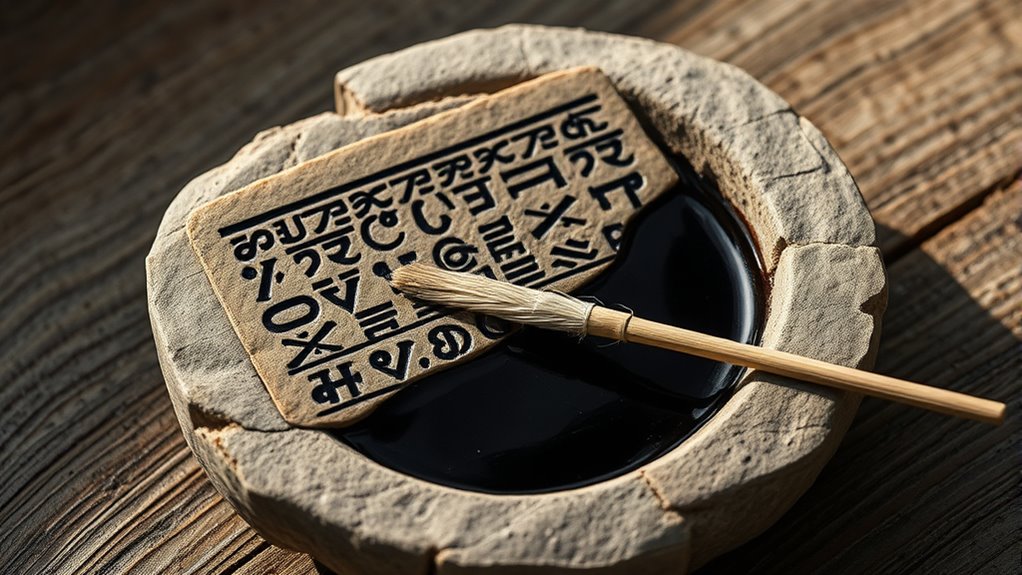
Have you ever wondered where ink first came from in ancient civilizations? The origins of ink go back over 4,000 years, with early forms appearing in Egypt and China.
In ancient Egypt, around 2500 BCE, people used soot mixed with gum Arabic to make ink for writing on papyrus. This shows their resourcefulness in creating useful writing tools.
Chinese civilizations also developed their own ink based on carbon black and natural binders around 256 BC. Early inksticks became essential for calligraphy and documentation.
These ancient inks mainly relied on carbon, soot, and minerals. They reflected the environment and culture of the time.
Over the years, different civilizations refined their ink recipes, but core materials like carbon black stayed consistent. These ingredients served as the foundation for writing and record-keeping across ages.
Who Created the First Known Ink Recipes?
The creators of the first known ink recipes laid the foundation for writing systems used thousands of years ago. Early recipes varied, but some key innovations stand out.
Imagine: Ancient China’s soot mixed with animal glue and water, creating a simple but effective ink. Egyptians used mineral pigments like ocher and iron to produce durable inks on papyrus.
Ancient China’s soot and animal glue crafted simple, effective ink; Egyptians used minerals like ocher for durable writing on papyrus.
Europeans developed iron gall ink in 1596, combining tannic acids from gallnuts with iron salts for longevity. These early recipes used plant-based inks and iron salts, showing resourcefulness across cultures.
The Egyptians’ mineral pigments and China’s soot laid the groundwork, while Europeans refined the process with iron gall ink, making it one of the most enduring and historically significant formulas.
How Did Chinese and Egyptian Inks Develop Independently?
While early ink recipes across different cultures shared common goals, such as creating durable, visible marks, the development of Chinese and Egyptian inks followed different paths shaped by their unique environments and materials.
Egyptian ink, developed around the 26th century BC, relied on mineral pigments like ocher and iron compounds. They used these as liquid suspensions for writing on papyrus.
In contrast, Chinese ink originated over four millennia ago, mainly made from carbon black like lampblack, combined with animal glue and mineral pigments. This led to the creation of solid inksticks, which were ground with water for brush application.
The development of Egyptian and Chinese inks reflects their cultural needs and available resources. Egypt focused on mineral-based inks, while China pioneered carbon black-based, solid ink sticks.
When Did the Iron Gall Ink Revolution Happen?
The iron gall ink upheaval began around the 5th century AD and became the main ink used in medieval Europe. Its composition, made from gallnuts and iron sulfate, gave it unmatched durability for centuries.
Despite its strength, its corrosive nature caused issues. This led people to look for more stable alternatives over time.
Origins and Composition
When did the iron gall ink upheaval happen, transforming writing practices across centuries? Around the 5th century AD, iron gall inks emerged, revolutionizing manuscripts with their durability and rich black tone.
The composition involved three key steps:
First, extracting tannic acid from gallnuts, which are thorny growths on oak and chestnut trees.
Next, combining this tannic acid with iron sulfate to create a dark, iron-based pigment.
Finally, applying this mixture with quills or brushes to medieval manuscripts and documents.
This process produced a long-lasting ink that became the standard for legal texts, artworks, and writings through the medieval period. Its unique composition made it both invaluable and influential, shaping how history was recorded for centuries.
Durability and Issues
Have you ever wondered when iron gall ink truly transformed writing? This ink, made from gallnuts and iron salts, offered remarkable durability. It was the standard in Europe from the medieval period through the 19th century.
Its permanence gave it great historical significance, as many manuscripts still survive today. However, its high corrosiveness caused damage to paper over centuries, leading to preservation issues.
The corrosive nature of iron gall ink eventually prompted innovations in ink chemistry, especially in the 19th century. Researchers sought less damaging, more stable alternatives.
The shift away from iron gall ink marked an important turning point. It balanced the desire for durability with the need to prevent paper deterioration.
This evolution highlights both the brilliance and limitations of early ink formulations.
Historical Significance
Ever wondered when iron gall ink really changed the way we write and keep records? The big breakthrough happened around the 5th century AD when this tough ink started being used all over Europe. Its importance in history is huge, shaping medieval manuscripts and Renaissance documents that are still around today.
Imagine this:
- Extracting tannic acids from gallnuts, creating a powerful ingredient.
- Mixing it with iron sulfate to make a dark, long-lasting ink.
- Using it to preserve priceless records and artworks for centuries.
This iron gall ink was valued for its durability, allowing scribes and artists to leave lasting marks. Thanks to its toughness, it became the go-to for preserving documents and art, marking a key moment in history. Even though it’s corrosive, its impact on European culture and record-keeping can’t be denied.
What Contributions Did European and Indian Cultures Make to Ink History?
European cultures introduced innovations like iron gall ink, which became essential for medieval manuscripts. Later, they developed oil-based inks that improved printing quality.
Meanwhile, Indian contributions, especially through Chinese ink manufacturing techniques involving carbon black and natural binders, influenced ink durability and versatility.
Together, these cultures shaped the evolution of ink by blending scientific advances with artistic expression.
European Innovations in Ink
During the Middle Ages, Europeans made significant strides in ink technology, especially developing iron gall ink, which became the standard for centuries. You can imagine their process:
They extracted tannic acids from galls and mixed it with iron salts to create a durable, black ink.
The invention of the printing press by Johannes Gutenberg in the 15th century transformed communication, using oil-based inks suited for metal movable type.
European artisans also experimented with binders and pigments, such as lead-based and carbon black inks, to improve durability and vibrancy.
European innovations advanced ink’s consistency and application, fueling the growth of manuscripts and printed books. These developments laid the groundwork for mass production and the spread of knowledge, shaping the history of ink profoundly.
Indian Contributions to Ink
While European innovations especially advanced ink technology, Indian contributions played a key role in shaping ink history. India ink, or masi, was invented around the 4th century BC by Indian artisans using soot, animal glue, and mineral pigments.
These artisans created detailed recipes, soaking bark, boiling it with wine, and grinding soot to make durable black inks used for religious texts and art. Early Indian inks relied heavily on carbon black and plant or mineral-based materials, which influenced ink practices across Asia.
The Indian contribution spread through trade routes, impacting Chinese and Middle Eastern ink formulations. When Europeans adopted Indian ink in the 17th century, it helped popularize carbon black for calligraphy and documentation worldwide, leaving a lasting mark on ink development.
How Did Synthetic Dyes Transform Modern Ink Chemistry?
The advent of synthetic dyes transformed ink chemistry by allowing for the production of vibrant, consistent, and durable colors that natural pigments couldn’t match. When William Henry Perkin accidentally discovered mauveine in 1856 through chemical synthesis, it opened a new era.
Synthetic dyes changed modern inks by producing bright, fluorescent hues that natural dyes couldn’t achieve. They also greatly improved colorfastness, preventing fading over time.
Another big change was enabling mass production, which made inks more affordable and widely available. These breakthroughs shifted ink chemistry from organic and mineral pigments to chemically synthesized colorants.
This expansion in options improved both the color palette and the longevity of inks. Thanks to synthetic dyes, modern inks are more vibrant and durable than ever before.
What Innovations Have Shaped Ink Production Today?
Innovations in ink production today are driven by cutting-edge technologies and a focus on sustainability. Modern ink technology uses synthetic dyes for vibrant, long-lasting colors, while advances in nanotechnology enable conductive and functional inks for electronics and biomedical applications.
Printing innovations now include water-resistant, quick-drying, and eco-friendly options made from plant-based oils and sustainable pigments. Oil-based inks, which played a big role in history, still influence today’s formulations but are now refined for better performance and a smaller environmental footprint.
The shift toward plant-based oils reduces reliance on fossil fuels and supports greener manufacturing practices. These technological developments lead to better print quality, faster production, and more environmentally conscious options.
Who Were the Key Pioneers in Functional and Electronic Inks?
Key pioneers in functional and electronic inks have shaped the way we integrate printing with technology. They developed innovations like conductive inks that enable flexible, printed circuits. You can imagine:
- Researchers at IBM and Xerox inventing silver nanoparticle inks, creating tiny, conductive pathways for printed electronics.
- Dr. John Rogers designing flexible, conductive inks for wearable tech, transforming how electronics bend and stretch.
- Scientists like Dr. Wei Gao developing carbon nanotube inks, making highly conductive, flexible materials for advanced devices.
These key pioneers pushed boundaries with functional inks, making possible flexible electronics, smart packaging, and printed sensors. Their work laid the foundation for today’s printed circuit boards and wearable tech, changing how we think about ink and electronics.
How Will Ink Evolve in the Future?
Advances in functional and electronic inks have already changed how we incorporate technology into everyday objects. The future of ink looks like it will include more eco-friendly formulas made from renewable plant-based oils and biodegradable pigments.
You’ll also see smart inks that respond to environmental stimuli or connect easily with digital devices. These are perfect for flexible electronics and wearables, making our tech more integrated and responsive.
Nanotechnology will play a big role by enabling inks with self-healing properties, better conductivity, or even dynamic color-changing features. Biocompatible inks will grow in medical fields, helping with tissue engineering and drug delivery.
To picture this future, think about these innovations:
| Technology | Application | Benefit |
|---|---|---|
| Environmentally sustainable inks | Eco-friendly printing | Reduced waste |
| Smart inks | Wearables & electronics | Increased functionality |
| Nanotechnology | Self-healing & conductivity | Durability & performance |
| Biocompatible inks | Medical use | Safety & innovation |
| Recyclable inks | Sustainable printing | Less environmental impact |
Frequently Asked Questions
Who Made the First Ink?
You should know that the first ink was likely created by ancient Egyptians around 2500 BCE, using soot mixed with gum Arabic for writing purposes. They developed this early form of ink to record their history and communicate.
Over time, different cultures like the Chinese and Indians refined ink formulas, creating solid inksticks and other varieties. But the Egyptians are credited with making the earliest known ink for writing.
Was Ink Invented or Discovered?
You might find it fascinating, but ink was more of a revelation than an invention. Ancient people stumbled upon natural pigments like charcoal and ocher that stuck to surfaces, helping them communicate and record.
Over time, cultures refined these discoveries into more sophisticated formulas. So, rather than being invented, ink evolved through natural discoveries and gradual improvements.
This process was driven by human curiosity and resourcefulness across centuries.
Are Squids Killed for Ink?
You’ll be glad to know that squids aren’t usually killed for ink anymore. Instead, their ink is collected through humane methods called “milking,” which stimulates the squid to release ink without harming it.
Modern practices focus on sustainable and ethical collection, so most commercial ink comes from live squids. This approach helps protect squid populations and reduces environmental impact.
Who Is the Father of Ink?
You should know there’s no single “father of ink” because it developed over centuries across different civilizations. Chinese artisans are often considered primary pioneers, creating early inksticks around 256 BC and using ink for writing as early as 2300 BC.
European scribes later advanced ink technology with iron gall ink in the 5th century AD. So, ink’s invention results from many inventors’ contributions, rather than just one person.
Conclusion
As you trace the journey of ink, you’ll see it’s a story written across centuries—like a river carving through stone. From ancient scribes to modern scientists, each invention has added depth and color to your world.
As technology advances, ink will continue evolving, turning the blank page into a canvas of endless possibilities. The invention of ink is credited to many, with early forms dating back thousands of years.
So, keep your eye on the horizon—who knows what new shades and stories will emerge next? After all, the story of ink is ongoing, shaped by those who seek to leave their mark.