How Is Pen Ink Made?
Are you tired of dull, fading ink that doesn’t stand the test of time? You’re not alone — many people struggle with finding the perfect pen ink that delivers vibrant color and lasting quality. Luckily, understanding how pen ink is made can help you choose the best options for your writing needs.
To make pen ink, manufacturers mix dyes or pigments with solvents, resins, and additives to create the desired color, durability, and flow. Dyes produce bright, vibrant colors but fade faster, while pigments offer opacity and resistance.
Solvents influence thickness and drying time, and additives improve stability, drying, and smooth writing. The process involves careful blending, filtering, and quality checks.
Keep exploring to uncover more about the fascinating science behind ink creation.
Key Takeaways
- Pen ink is made by mixing dyes or pigments with resins, solvents, and additives. This helps achieve the right color, stability, and flow.
- The ingredients are chosen based on what the ink needs to do. They are blended carefully under controlled conditions to keep everything uniform and consistent.
- After mixing, the ink goes through filtration to remove any impurities. It’s then tested for things like viscosity, how fast it dries, and overall stability before it gets packaged.
- Dyes dissolve evenly, giving the ink vibrant colors. Pigments add opacity and make the ink more durable. Solvents influence how thick or thin the ink is and how quickly it dries.
- Modern manufacturing often uses synthetic dyes, stabilizers, and eco-friendly additives. These improvements help make the ink more durable, perform better, and be safer to use.
What Are the Basic Ingredients Used to Make Pen Ink?
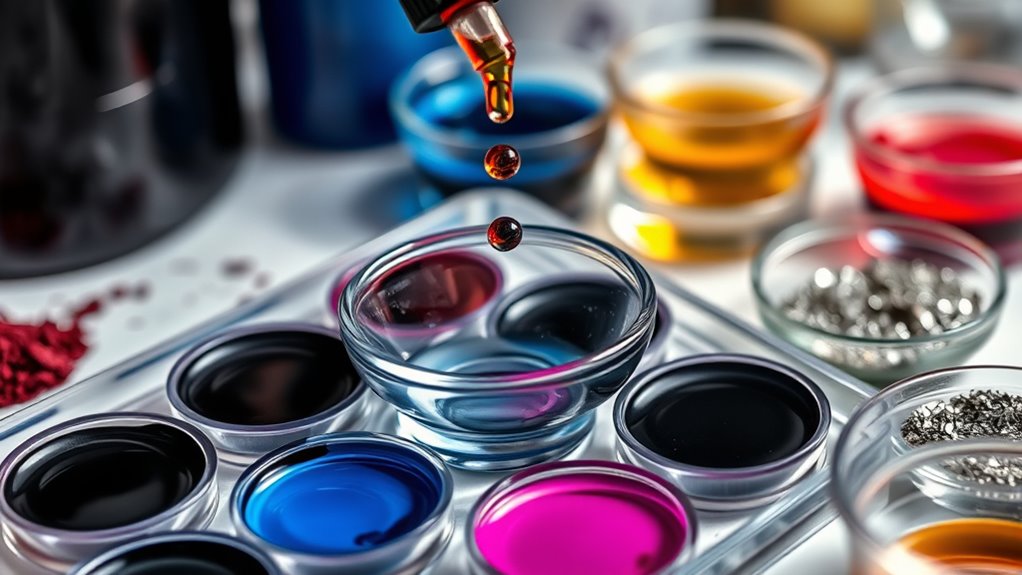
To make pen ink, manufacturers combine several key ingredients that work together to create the right color, flow, and durability. The main component is ink, which relies on dyes or pigments to provide color.
Pigments are tiny solid particles that give ink its opacity and vibrancy, especially in more durable or archival inks. These pigments are suspended in a solvent, such as water or oil-based liquids, which dissolves dyes or keeps the pigments evenly dispersed.
Resins act as binders, helping the ink stick to paper fibers and form a long-lasting film. Additives like surfactants, humectants, and stabilizers are also included to improve flow, control drying time, and maintain stability.
The exact ingredient mix varies depending on the type of ink and its intended use.
How Do Pigments and Dyes Affect Ink Color and Durability?
The type of coloring agents used in ink—whether pigments or dyes—significantly influences both its appearance and longevity. Dyes dissolve evenly in ink, producing bright, vivid colors, but they tend to fade faster over time.
In contrast, pigments sit on the surface, offering opacity and greater resistance to fading. This makes them ideal for long-lasting or archival ink applications.
Dyes provide a broader color range and are easier to dissolve, but their colors are less durable. Pigments are more resistant to environmental factors like light and moisture, which enhances the ink’s stability.
Your choice between dyes and pigments affects not only the ink’s vibrancy but also its ability to withstand wear and environmental degradation. This impacts how long your writing remains clear and colorful.
What Role Do Solvents Play in Pen Ink Manufacturing?
Solvents are essential in pen ink manufacturing because they dissolve dyes or suspend pigments, making sure the ink flows smoothly and spreads evenly. They also affect how thick or thin the ink is, with oil-based solvents making it thicker and water-based ones keeping it thinner.
The rate at which the solvent evaporates is key to how fast the ink dries on paper. Faster-evaporating solvents mean quicker drying times, which is often desirable.
Plus, solvents help keep the ink stable and prevent clogging by controlling its consistency and flow. The kind of solvent used influences not just how well the ink performs but also factors like odor, toxicity, and whether it’s compatible with pen materials.
How Are Additives Used to Improve Pen Ink Performance?
Additives play an essential role in enhancing pen ink performance by modifying its physical properties and ensuring consistent results.
Surfactants, also known as wetting agents, reduce surface tension, helping the ink flow smoothly and spread evenly on paper. This prevents skipping and uneven lines.
Surfactants lower surface tension, ensuring smooth ink flow and even spreading on paper.
Humectants like glycerin keep the ink moist longer, maintaining a consistent writing experience without drying out too quickly.
UV stabilizers and antioxidants protect the ink from fading and chemical degradation over time.
Thickeners and drying agents optimize viscosity, allowing the ink to dry faster and reducing smudging.
Anti-settling agents keep pigments and dyes evenly suspended, ensuring your ink maintains its vibrant color and reliable performance throughout its shelf life.
These additives work together to improve ink quality and usability.
How Is Pen Ink Made? A Step-by-Step Manufacturing Process
To make quality pen ink, you first choose the right dyes or pigments based on the color and properties you want.
Next, you mix these with solvents and additives. Then, blend and filter the solution for consistency.
Throughout this process, strict quality control guarantees each batch meets the desired standards before packaging.
Ingredient Selection Process
The ingredient selection process is a key step in making high-quality pen ink because it affects the color, durability, and overall performance. You start by choosing the right ingredients, like water-soluble dyes or inorganic pigments, based on the desired color intensity and how well the ink resists fading.
Next, you pick solvents such as water, alcohols, or glycols to control how thick the ink is, how quickly it dries, and how smoothly it flows. Then, you add ingredients like surfactants, humectants, and stabilizers to improve performance, prevent microbial growth, and keep the ink stable over time.
Finally, resins and binders are selected to help the ink stick to paper better and to improve durability, smudging resistance, and fading. These ingredients are carefully measured, combined, and mixed in controlled conditions to create a consistent and stable ink formulation.
Mixing and Blending Techniques
Mixing and blending techniques are essential steps that guarantee the uniform distribution of dyes, pigments, and other ingredients in pen ink. During mixing, you combine dyes or pigments with solvents, resins, and additives to achieve specific color, flow, and drying characteristics.
Blending often involves dissolving dyes in water-based solvents or suspending pigments in oil-based carriers, using mechanical agitators for even dispersion. Proper blending ensures consistent particle size and prevents separation.
To improve the process, manufacturers typically use mechanical agitators for thorough mixing, incorporate surfactants and stabilizers during blending, and dissolve dyes or suspend pigments uniformly. They also perform continuous stirring to maintain consistency and filter the mixture to remove impurities.
This careful combination guarantees that the ink’s quality remains stable and vibrant.
Quality Control Measures
Quality control measures are crucial to guarantee that each batch of pen ink meets strict standards for consistency, safety, and performance. Before mixing, raw materials are tested for purity, color stability, and compatibility to prevent defects.
During production, ingredients are blended under controlled temperature and agitation to ensure uniform dispersion and avoid separation. The ink undergoes rigorous testing for viscosity, drying time, flow, and color intensity to meet industry standards and customer expectations.
Final quality checks include stability testing, contamination screening, and packaging integrity assessments. These procedures help identify any issues early, ensuring only high-quality ink reaches consumers.
How Do Manufacturers Ensure Consistency and Quality in Pen Ink?
Manufacturers guarantee consistency and quality in pen ink by employing precise formulations and controlled manufacturing processes. They use advanced mixing techniques and high-quality raw materials to ensure dyes, pigments, and additives are evenly dispersed.
To maintain standards, they test ink viscosity, drying time, color stability, and pH levels regularly. Automation and strict process monitoring help reduce variability and keep each batch within performance specifications.
Regular calibration of equipment and rigorous inspection protocols further ensure consistent results. These measures help deliver reliable, high-quality ink every time.
What Types of Fountain Pen Ink Are Available and How Are They Made?
Have you ever wondered what makes fountain pen inks so versatile and varied? It’s mainly due to the different types of dyes used in their formulation.
Fountain pen inks are primarily dye-based because dyes dissolve easily in water and help boost capillary action, making the ink flow smoothly. These inks include various categories like colored dyes, black dyes, and security inks, each with specific chemical compositions tailored for different purposes.
Manufacturers add surfactants for better flow, humectants like glycerin for lubrication, and preservatives to extend shelf life. Some specialized inks even incorporate nanoparticle formulations for waterproof and fade-resistant properties.
To improve longevity and compatibility with pens, they often include resins, pH stabilizers, and anti-corrosion agents. This results in a wide range of vibrant, durable inks.
How Does Ballpoint Pen Ink Differ in Composition and Production?
Ballpoint pen ink differs from fountain pen ink mainly in its composition, with more resins and thickeners for better adhesion and quick drying.
The production process involves mixing dyes or pigments with oil-based vehicles and additives to achieve the right viscosity and flow.
These factors help ensure the ink writes smoothly, dries fast, and resists smudging on paper.
Composition Differences Explained
Unlike fountain pen ink, ballpoint pen ink is designed to be thicker and less water-soluble. This is key for quick-drying and smudge-resistant writing.
The formula focuses on making a viscous ink that stays on the paper’s surface. Manufacturers mix dyes or pigments with specific solvents, resins, and stabilizers to achieve this.
These additives help the ink stick better and dry faster. The viscosity is carefully controlled to ensure smooth flow through the ballpoint mechanism.
The main differences in composition include using resins for better adhesion, a thicker base to reduce water solubility, and stabilizers to keep everything consistent.
Production Process Overview
The production process of ballpoint pen ink involves carefully mixing its main ingredients—dyes or pigments, solvents, resins, and additives—under controlled conditions to ensure consistency and stability. During manufacturing, these components are blended to create a uniform, thick ink that resists smudging and dries quickly.
To guarantee quality, the ink is filtered to remove impurities that could clog pen mechanisms. The process focuses on making the ink durable, easy to flow, and stable over time.
| Step | Purpose |
|---|---|
| Mixing ingredients | Achieves a uniform composition |
| Filtration | Removes impurities for consistency |
| Final blending and testing | Ensures stability and performance |
This careful manufacturing process ensures your ink performs reliably in every pen.
Ink Performance Factors
Because of its oil-based formulation, ballpoint pen ink is designed to flow smoothly through the tiny ball mechanism without clogging or leaking. Performance depends heavily on its composition. The key factors include dyes or pigments that provide vibrant, consistent color, and viscosity, which controls how easily the ink moves.
To guarantee reliable writing, manufacturers add resins and additives that improve adhesion and prevent smudging. The formulation process involves dispersing dyes or pigments in viscous oil-based solvents, with stabilizers and thickeners to regulate flow and drying time.
A proper balance of these elements guarantees smooth ink flow and prevents clogging. The dyes and pigments give the ink its color vibrancy, while viscosity helps control how easily the ink moves. Resins help the ink stick better to paper, making the writing more durable.
Additives are included to prevent smudging, ensuring clean writing. Stabilizers help manage drying time, so the ink doesn’t smudge or smudge less. Overall, these factors work together to create ink that flows smoothly and performs reliably.
What Safety Measures Are Taken During Ink Manufacturing?
Manufacturers prioritize safety during ink production by implementing strict quality control protocols to guarantee ingredient purity and prevent contamination. These safety measures help *assure* the chemical stability of the inks, reducing risks of hazards during manufacturing and use.
Production occurs in well-ventilated facilities, and workers wear protective gear such as gloves, goggles, and respirators when handling hazardous chemicals like dyes, solvents, and additives. Automated equipment is used for mixing and formulation, minimizing human contact with concentrated substances.
Compliance with safety regulations from agencies like OSHA and EPA guides waste disposal and emission controls, further safeguarding the environment and workers. Regular testing for toxicity and flammability confirms that the final products are safe for consumers and manufacturing personnel alike.
How Do Modern Inks Compare to Historical Formulations?
Modern inks are quite different from historical recipes. They mainly use synthetic dyes and pigments instead of natural materials like carbon black and vegetable dyes.
Thanks to advances in chemistry, modern inks include additives that improve stability, drying time, and water resistance. This makes them more specialized and reliable.
These technological improvements have also expanded the range of colors and boosted performance. Unlike in the past, where recipes were more variable, today’s inks are more consistent and high-performing.
Composition Differences Over Time
Over time, the composition of pen inks has evolved dramatically, shifting from simple natural ingredients to complex, chemically engineered formulations. Early inks used soot or lampblack with water or plant-based vehicles, lacking stabilizers or additives. These inks often caused clogging in modern fountain pens and had limited durability.
Today’s inks incorporate synthetic dyes, resins, surfactants, and stabilizers to improve flow, drying time, and resistance to fading or water damage. The 19th-century chemical manufacturing upheaval allowed for consistent, highly pigmented, and durable inks.
Modern formulations often include UV stabilizers and anti-fungal agents, reflecting significant technological progress. The shift from natural to synthetic dyes, along with advanced additives, has greatly increased durability and water resistance.
Technological Advances in Ink
Advances in chemical engineering have transformed ink formulations, allowing for greater control over performance characteristics. Modern fountain ink benefits from nano-pigments and advanced stabilizers, making it more water-resistant, fade-proof, and durable than historical options.
Synthetic chemistry enables precise adjustments of viscosity and drying time, ensuring consistent flow and application. Contemporary inks incorporate UV absorbers and anti-fungal agents, extending their lifespan and resistance to environmental factors.
The development of dye- and pigment-based inks with engineered particle sizes creates unique effects like shimmer, fluorescence, and security features that weren’t achievable before. Modern manufacturing techniques such as sophisticated mixing, milling, and filtration produce highly uniform inks with longer shelf lives and fewer impurities.
This results in a more reliable and versatile product compared to traditional formulations.
What Common Challenges Occur in Ink Production, and How Are They Solved?
Creating consistent, high-quality ink involves overcoming several common challenges during ink manufacturing. Variations in raw materials like dyes, pigments, and solvents can make it tough to maintain uniform color and viscosity.
To fix this, manufacturers use precise mixing techniques and stabilizers to prevent sedimentation and separation of pigment particles. Achieving the right drying time without smudging requires careful formulation of solvents and additives.
Controlling pH and chemical stability is essential to prevent degradation or microbial growth, often through pH adjusters and biocides. Balancing environmental safety with performance involves reducing VOCs while still keeping the ink quality high.
- Ensuring uniform pigment particle size
- Preventing sedimentation and separation
- Achieving ideal drying time
- Maintaining chemical stability and pH
- Balancing eco-friendliness with performance
Where Can You Learn More About How Pen Ink Is Made?
If you’re curious about how pen ink is made, there are many resources that can give you detailed information. Websites like Glenn’s Pens and The Vintage Pens Website provide in-depth insights into how ink is manufactured and the specifics of fountain pen ink.
Explore detailed insights into pen ink manufacturing and fountain pen ink specifics through dedicated websites and resources.
Academic journals, such as those from the Royal Society of Chemistry, publish research articles on ink chemistry and production techniques. Books like “Fountain Pen Ink” by Glenn Marcus offer comprehensive details on ingredients and manufacturing methods.
Industry reports and publications from major ink manufacturers reveal the technical aspects of ink formulation. Online forums and communities dedicated to pen enthusiasts and calligraphy are also great for sharing practical knowledge and experiences about ink making.
These resources help you learn both the science behind and the craft of pen ink production.
Frequently Asked Questions
What Are the Ingredients of Pen Ink?
You’ll find that pen ink mainly contains dyes or pigments for color, dissolved or suspended in solvents like water or oil. Resins help the ink stick to paper and stay durable.
Additives such as surfactants and stabilizers improve flow, drying time, and prevent microbial growth. The exact recipe varies by manufacturer, but these key ingredients work together to create smooth, lasting ink that writes well.
How Is Pen Ink Made Today?
Today, pen ink is made by dissolving dyes and chemicals in solvents like water, alcohol, or glycol. This creates a smooth, consistent flow for your pen.
About 80% of modern inks are dye-based because they work well with fountain pens. You’ll find additives like surfactants and stabilizers included to improve flow, prevent mold, and ensure your ink stays vibrant.
Resins are added for better adhesion, making sure your ink writes smoothly and lasts longer.
Is Ink From Animals Used in Pens?
No, ink from animals isn’t used in pens today. Modern inks mainly rely on synthetic dyes, resins, and water-based carriers, with little to no animal-derived ingredients.
Historically, some inks contained animal components like bone black or shellac, but those are mostly replaced now. If you’re concerned about animal products, you’ll find many vegan-friendly inks available, ensuring your writing is cruelty-free and environmentally conscious.
Why Can’t China Make Ballpoint Pens?
You might be surprised, but China struggles to produce high-quality ballpoint pens because it lacks advanced manufacturing technology. Only about 30% of its factories have the necessary equipment.
Many factories focus on cheap, generic pens instead of premium ones. Strict quality standards and restrictions on access to proprietary technology make it hard for China to develop innovative, high-precision ballpoint pens that meet global standards.
Conclusion
Now that you know how pen ink is made, you see it’s more than just a simple mixture. It’s a craft that combines chemistry and creativity.
With each step, from selecting pigments to adding stabilizers, the process is like a finely tuned orchestra.
So, the next time you jot down a note or sketch a masterpiece, remember the magic behind the ink.
It’s true what they say—great things happen when you don’t cut corners.