
A Brief Guide to the History of Ink Inventions
Many people struggle with choosing the right ink for their needs, whether it’s for art, writing, or printing. You’re not alone—navigating the world of ink can be confusing with so many options out there.
You’ll find that ink dates back thousands of years, with early uses in Egypt and China involving soot, animal glues, and mineral pigments. Over time, inventions like the printing press and industrial innovations introduced durable, vibrant, and faster-drying inks.
Modern advances include digital and secure voting inks, blending tradition with technology. If you’re curious about how ink has evolved from ancient formulas to modern science, there’s much more to explore ahead.
Key Takeaways
- Ancient civilizations like Egypt and China came up with early ink formulas around 2500 BCE. They used soot, animal glues, and mineral pigments to create their inks.
- Then, during Medieval Europe, the invention of iron gall ink made a big difference. It was durable and long-lasting, perfect for manuscripts that needed to stand the test of time.
- When the printing press was invented in the 1440s, there was a need for better inks. This led to the development of thicker, oil-based inks that stuck well and dried faster.
- The Industrial Revolution brought big changes, too. Petroleum-based inks and synthetic dyes made colors brighter and more durable. They also made mass production easier and more efficient.
- Today, inks are super advanced. They include digital inks, conductive inks for electronics, and eco-friendly options. These innovations help meet a wide range of modern needs.
Where Did Ink Come From and How Was It Used Early On?
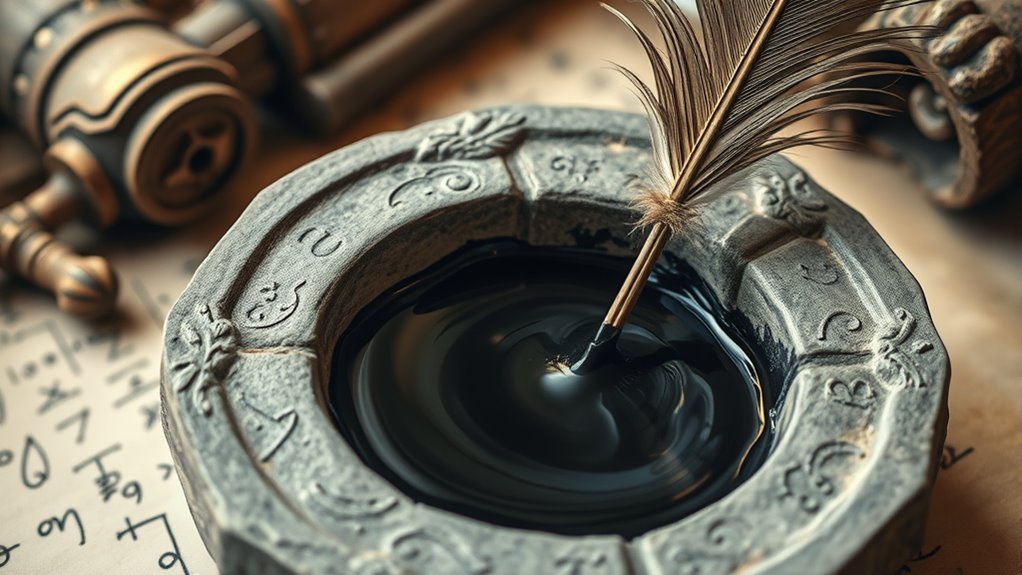
Ink has been around for thousands of years, with early civilizations creating it from natural materials they had nearby. Early inks, like those used by Egyptians around 2500 BCE, mixed soot with animal glues and gum Arabic to make durable black ink on papyrus.
These inks were water-soluble but long-lasting, perfect for recording religious texts and official records. Chinese inventors made solid inksticks over 5,000 years ago, which they ground with water on inkstones for calligraphy and painting.
In medieval Europe, iron gall ink was made using tannic acid from gall nuts, and it became a standard for manuscripts. Throughout history, different civilizations relied on locally available materials like soot, plant dyes, and animal glues to create inks suited to their artistic and recording needs.
How Did Ancient Civilizations Create Their Unique Inks?
Ancient civilizations used locally available natural materials like soot, plant dyes, and mineral pigments to make their inks.
These materials often had cultural or ritual importance, which influenced their choice of ingredients.
Knowing where these raw sources came from and what they meant culturally helps us see how their inks reflected each society’s values and traditions.
Raw Materials and Sources
Throughout history, civilizations relied on natural materials to craft their inks, drawing from resources in their environments. They used plant extracts, like gum Arabic from acacia trees, to bind pigments and make the ink last longer.
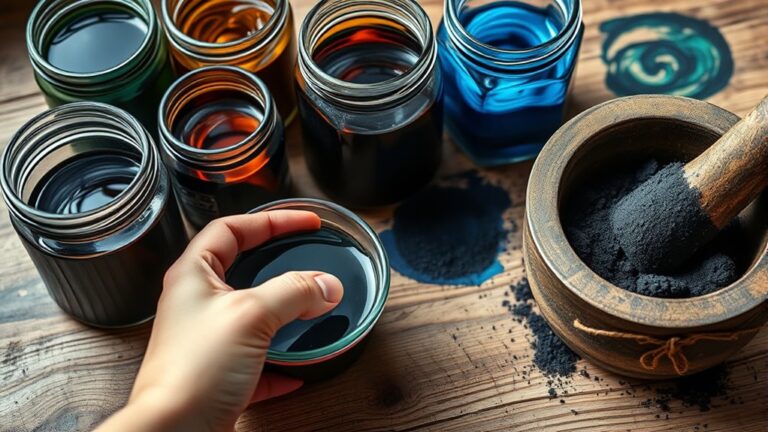
Soot and charcoal provided carbon black for black inks, such as those used by Egyptians, who mixed soot with water and plant-based gums. Mineral pigments, including indigo and clay minerals, created colorful inks by combining with natural binders.
Animal glue, made from animal hides or bones, helped fix pigments in Chinese inksticks. Tannic acid from gall nuts was processed with iron sulfate to produce the rust-colored iron gall ink used in medieval Europe.
These traditional sources formed the foundation for the diverse ink recipes across ancient civilizations.
Ritual and Cultural Significance
Civilizations didn’t just craft inks from natural materials. They also infused them with deep cultural and spiritual meaning through specific rituals and procedures.
These ritual acts, like heating Maya Blue in incense burners or grinding Chinese inksticks on inkstones, carried profound symbolism.
Such sacred procedures reinforced cultural identity and spiritual beliefs. They transformed simple pigments into symbols of authority, scholarly tradition, or divine connection.
The Maya’s careful creation of Maya Blue reflected their reverence for permanence and spirituality.
Likewise, Chinese ink’s meticulous craftsmanship highlighted artistry and respect for tradition.
In medieval Europe, preparing Iron Gall ink symbolized scholarly authority and reverence for knowledge.
These traditional, sacred procedures elevated ink-making into meaningful acts. They underscored its essential role in cultural and spiritual expression.
What Materials Were Traditionally Used in Historic Inks?
Historically, inks were made from a variety of natural materials that gave them rich, lasting color. These included soot and charcoal mixed with water or animal glue to create deep blacks, like carbon black used in Chinese inksticks.
Medieval iron gall ink relied on gall nuts containing tannic acid, which reacted with iron salts to produce a durable, dark ink. Natural dyes like indigo from plants provided vibrant colors, while minerals such as cinnabar and ochre created vivid, long-lasting hues.
- Soot and charcoal for intense blacks, evoking emotion through their boldness.
- Gall nuts for the enduring power of medieval ink.
- Mineral pigments like cinnabar for vibrant, durable colors.
How Did the Printing Press Change Ink Formulations?
The invention of the printing press in the 1440s sparked a radical change in ink formulations. Traditional water-based inks proved inadequate for mass production.
To ensure effective printing on metal movable type and paper, thicker, more viscous oil-based inks were developed. These inks contained carbon, graphite, copper, lead, titanium, and sulfur, creating a reflective sheen and vibrant color.
They offered better adherence, durability, and resistance to smudging, which were essential for high-volume production. The quick-drying nature of oil-based inks enabled faster printing processes, reducing delays and increasing efficiency.
This shift transformed printing, making it possible to produce large quantities of books and documents consistently. Oil-based inks set new standards and facilitated the move from manuscript copying to mass printing.
What Were the Major Ink Innovations During the Industrial Revolution?
During the Industrial Movement, major advancements in ink technology changed how printing was done. You saw the rise of petroleum-based inks that dried faster and offered better print quality, helping with mass production.
Synthetic dyes, like mauveine discovered in 1856, gave you a wider range of vibrant colors and ensured consistent hues. Carbon black, made from the incomplete combustion of heavy oils, provided a stable, intense black pigment for various industrial uses.
These ink innovations made printing more durable and suitable for high-speed presses. The chemical breakthroughs behind these innovations allowed for the mass production of vibrant, long-lasting inks.
As a result, you experienced a new era of efficient printing with inks that met the demands of the industrial revolution. The three major innovations include:
- Petroleum-based inks for faster drying
- Synthetic dyes for vibrant colors
- Carbon black for stable black pigments
How Did Synthetic Dyes and Chemicals Revolutionize Ink?
Synthetic dyes and chemicals transformed ink by making colors more vibrant and consistent, so your writing really stands out. They also boosted durability, helping ink resist water and fading over time.
Plus, the expanding color palette means you have more options for every purpose, making your choices even more versatile.
Enhanced Color Brightness
When synthetic dyes like William Henry Perkin’s mauveine appeared in 1856, they instantly changed ink by providing vibrant, consistent colors that natural dyes just couldn’t match. These innovations significantly boosted ink brightness and colorfastness, making prints more vivid and durable.
Chemical additives further improved ink opacity, shine, and resistance to fading, resulting in eye-catching, long-lasting prints. The development of synthetic dyes expanded the color palette, allowing inks to display more intense and diverse shades than ever before.
This revolution in dye development made ink production more reliable and versatile. It fueled artistic expression and commercial printing alike.
Experience the thrill of richer, more vibrant colors that grab your attention.
Witness inks that resist fading, keeping your prints striking over time.
Enjoy a broader spectrum of colors that transform visual storytelling forever.
Improved Ink Durability
The introduction of synthetic dyes in the mid-19th century was a game-changer, not just for making colors more vibrant but also for making inks more durable. These dyes, along with advanced chemical formulas, greatly improved ink longevity and colorfastness.
Chemical additives like resins, binders, and stabilizers helped inks stick better and resist fading, moisture, and chemicals. This innovation led to archival inks and water-resistant formulas that keep documents and artwork preserved over time.
Modern chemical formulas also help inks dry faster, resist smudging, and withstand environmental exposure. Overall, synthetic dyes and chemical additives have set new standards for ink durability, making them last much longer.
Expanded Color Range
Before synthetic dyes, ink colors were limited and often inconsistent, making it hard to get bright, varied hues. The invention of synthetic dyes in 1856, starting with William Henry Perkin’s mauveine, changed everything by introducing vibrant, stable colors.
These dyes expanded the color palette, allowing inks to feature bright hues that natural dyes couldn’t provide. Their chemical stability also improved colorfastness, reducing fading over time.
This innovation led to a larger range of pigments, creating more diverse and vivid shades. It also lowered costs, making colorful inks accessible to everyone.
Plus, the quality of ink improved with more consistent and vibrant colors for printing and art. Synthetic dyes truly transformed ink into a medium capable of limitless creativity and precision.
What Types of Ink Are Used Today and How Are They Different?
Today’s inks are highly specialized to suit various printing and electronic needs, with different compositions and properties tailored to each application.
Modern inks vary widely in chemical makeup, from water-based inks for inkjet printers to oil-based inks for offset printing and pigment-based inks for archival purposes. Digital inks, like conductive and smart inks, are designed for electronic uses such as printed circuits and wearable devices.
Modern inks range from water-based for printing to conductive for electronics, each tailored for specific applications and durability.
Voting ink, often containing silver nitrate, creates indelible stains resistant to washing and chemicals. Many modern printing inks incorporate synthetic dyes or pigments, with some formulated to be environmentally friendly using vegetable oils.
The main differences among these inks lie in their drying properties, durability, and specific application requirements. This makes each type unique for its intended purpose.
How Are Modern Inks Made and Formulated?
Modern inks are crafted through careful formulation, combining a vehicle like a solvent or binder with a coloring agent such as pigments or dyes. This blend creates a consistent, vibrant product tailored for specific printing needs.
You’ll find that:
- Precise formulation involves finely ground pigments or dyes, stabilized to guarantee uniform color and prevent settling.
- Additives like surfactants, stabilizers, and drying agents improve adhesion, flow, and drying times, making inks more efficient.
- Eco-friendly options incorporate renewable vehicles like soy or vegetable oils, reducing environmental impact without compromising quality.
Every component plays a crucial role in producing inks that are reliable, vibrant, and suited for various printing methods.
What Are the Breakthroughs in Digital and Inkjet Ink Technology?
Advancements in inkjet nozzle precision have greatly improved print resolution and speed, making high-quality images more accessible.
Meanwhile, innovations in pigment stability guarantee longer-lasting, vibrant prints even under challenging conditions.
Cost reduction strategies have also made digital printing more affordable, expanding its use across various industries.
Inkjet Nozzle Precision
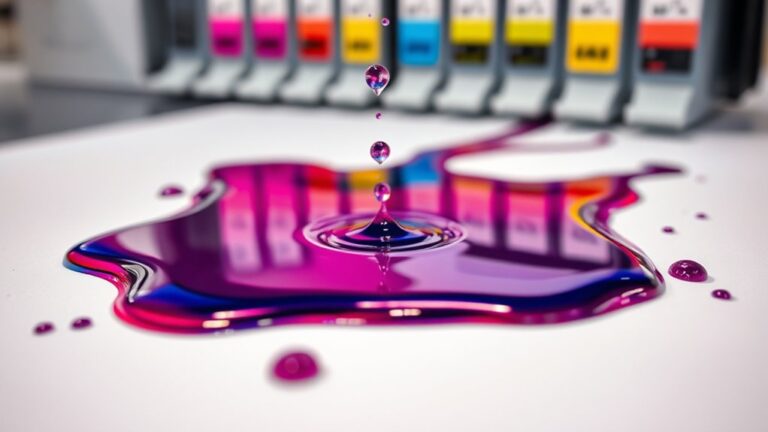
The precision of inkjet nozzles has dramatically improved thanks to innovations in micro-electromechanical systems (MEMS), which enable the production of extremely tiny droplets—typically between 1 and 20 picoliters. This advancement boosts nozzle precision, allowing for unparalleled control in droplet ejection and achieving ultra-high print resolution.
Breakthroughs include the development of multi-nozzle arrays that facilitate rapid, multi-color printing and technologies like piezoelectric and thermal bubble systems that accelerate droplet size adjustments. These innovations result in:
- Unmatched print clarity with placement accuracy within ±2 micrometers.
- Faster printing speeds through efficient droplet ejection.
- Enhanced reliability with self-cleaning and adaptive nozzles.
Together, these innovations set new standards in digital printing precision and quality.
Pigment Stability Advances
Recent breakthroughs in nanoparticle technology have significantly improved pigment stability in digital and inkjet inks, preventing issues like agglomeration and sedimentation that can affect print quality.
Polymer encapsulation enhances pigment dispersibility and increases resistance to environmental degradation, helping prints last longer.
Modern formulations now include UV stabilizers and antioxidants, which protect colors from fading caused by UV exposure and oxidative damage.
Inorganic pigments, such as mineral-based options, offer superior thermal and chemical stability, maintaining vividness over time.
Surface modification techniques also play a role by improving pigment compatibility with both aqueous and solvent-based inks, boosting overall stability and performance.
Together, these advances raise pigment stability and color longevity, resulting in more durable, vibrant digital and inkjet prints with better resistance to environmental factors.
Cost Reduction Strategies
Innovations in ink technology have not only improved quality and durability but also helped lower costs, making digital and inkjet printing more accessible. You benefit from breakthroughs like:
- Piezoelectric printheads that enable precise ink flow control, increasing speed and reducing manufacturing costs.
- Water-based, dye-based inks with better formulation stability, allowing for lower production costs and wider consumer access.
- Standardized, mass-produced ink cartridges with integrated chips, helping manufacturers cut costs and better manage ink usage.
Advances in nanotechnology also played a key role by creating smaller, more efficient pigments that reduce material expenses. Switching from solvent-based to eco-friendly inks further lowered production costs and eased regulatory challenges, making ink manufacturing more cost-effective and sustainable.
Why Is Voting Ink Important for Democratic Elections?
Voting ink plays an essential role in making sure democratic elections are fair. It helps prevent people from voting more than once and stops electoral fraud.
This ink is an indelible substance made with silver nitrate. It reacts with salts on the skin to leave a stain that lasts for days or even weeks.
It’s a simple way to verify who has already voted, which boosts election security. Proper use of the ink is important because misapplication can harm election integrity.
India popularized voting ink in 1962, and since then, it has become a global symbol of honest voting.
The use of voting ink shows how effective it is in keeping elections honest and fighting fraud.
| Aspect | Explanation |
|---|---|
| Indelible ink | Reacts with skin salt, lasting until skin sheds |
| Voter verification | Confirms who voted, prevents double voting |
| Election security | Reduces electoral fraud, maintains process integrity |
| Historical use | Widely adopted since 1962, especially in India |
| Electoral fraud | Voting ink is a key tool in combating it |
How Does the Cultural and Historical Significance of Ink Shape Its Use Today?
The cultural and historical significance of ink deeply influences how we use and value it today. It preserves cultural heritage through indelible ink, linking us to past traditions and identity. This significance fuels respect for traditional craftsmanship and artistic expression, seen in calligraphy and manuscript art that continue to inspire modern design.
Consider these emotional connections:
- The durability of indelible ink symbolizes trust and authenticity in legal and political records.
- Its role in preserving religious, literary, and political texts underscores the importance of cultural heritage.
- The ritualistic use of inks fosters a sense of continuity, honoring centuries-old practices and ensuring their preservation.
Today, ink’s cultural significance shapes innovations focused on security, authenticity, and honoring tradition.
What Does the Future Hold for Ink Innovation and Sustainability?
As technology advances, the future of ink is heading toward more sustainable and versatile options that can meet the growing needs of different industries. Expect to see innovative inks like bio-compatible, smart, and conductive types transforming wearable tech, medical devices, and flexible electronics.
Eco-friendly inks will focus on renewable resources like vegetable oils and aim to reduce VOCs, helping to lessen environmental impact. Improved recyclability and durability will also be key, making inks that resist fading and last longer, fitting the demands of digital and industrial sectors.
Emerging technologies might even enable inks to change color or respond to environmental stimuli. This opens up exciting new possibilities for interactive and responsive applications.
Frequently Asked Questions
How Have Environmental Concerns Influenced Modern Ink Formulations?
Environmental concerns have led you to choose greener ink options. Manufacturers now prefer water-based or soy-based inks instead of toxic solvents, which helps cut down pollution and health risks.
You’ll see more biodegradable ingredients and fewer volatile organic compounds (VOCs). These changes help protect ecosystems and make ink production more sustainable.
As a consumer, you can support eco-friendly inks. This encourages industries to focus on environmental health and come up with cleaner, safer formulations.
What Role Does Ink Play in Preserving Cultural Heritage?
Ink acts as a guardian of cultural heritage, symbolizing the enduring voice of traditions and stories across generations. When you use ink to preserve manuscripts, art, or inscriptions, you’re actively safeguarding history’s essence.
It captures the spirit of a culture, making sure its lessons and beauty survive beyond time. Your act of writing becomes a bridge, connecting past and future.
This process reaffirms that cultural identity lives on through the timeless flow of ink.
How Do Inkjet and Digital Inks Differ From Traditional Inks?
You notice that inkjet and digital inks differ from traditional inks in their composition and application. Inkjet inks are water-based and designed for precise, high-resolution printing on various surfaces.
Digital inks often include specialty formulations like UV-curable or solvent-based options. Traditional inks, on the other hand, are usually oil or pigment-based.
They are used in manual writing or printing presses and offer different durability, color vibrancy, and drying properties suited for specific uses.
What Innovations Are Driving Sustainable Ink Development Today?
You’ll find that innovations like soy-based inks and waterless technologies are transforming sustainability today. Did you know that soy-based inks can reduce volatile organic compounds (VOCs) by up to 60%?
These developments focus on eco-friendly ingredients, energy-efficient manufacturing, and biodegradable components. By embracing such innovations, you help reduce environmental impact, promote renewable resources, and support a greener future for printing and packaging industries.
How Has Ink Technology Impacted Artistic Expression Throughout History?
You see, ink technology has really shaped artistic expression by letting artists explore new styles, techniques, and mediums. It made detailed line work, vibrant colors, and permanence possible, helping artworks last for centuries.
As ink evolved, so did creativity. It gave painters, calligraphers, and illustrators the tools to push boundaries and try new things. You can see how innovations like waterproof or archival inks expanded what artists could do.
These advances made artworks more enduring and expressive throughout history, allowing artists to truly experiment and leave a lasting mark.
Conclusion
Think of ink as a timeless river, flowing through the ages, shaping civilizations and stories alike. As you explore its journey from ancient pigments to modern digital marks, remember that each drop carries a rich history and ongoing innovation.
The story of ink is a testament to human creativity, from early cave paintings to the sophisticated inks used in today’s printing presses. It’s a fascinating tale of discovery and adaptation that continues to evolve.
Looking ahead, the future of ink is like a shimmering stream, offering sustainable options and groundbreaking innovations. This ongoing journey reflects our commitment to preserving tradition while embracing progress.
Welcome this voyage, knowing you’re part of a vibrant, evolving legacy that keeps ink at the heart of communication and art. It’s a story that continues to ink the pages of tomorrow.