What Is Invisible Ink Technology and How Does It Work?
Are you tired of worrying about document security or your secret messages falling into the wrong hands? You’re not alone—many people struggle with keeping sensitive information safe. That’s where invisible ink technology comes in, offering a clever way to hide messages until the right moment.
Invisible ink technology uses special substances that hide messages until activated by specific stimuli like UV light, heat, or chemicals. These inks are made from organic compounds, nanomaterials, or advanced dyes, often incorporating microtaggants for security.
When exposed to the right stimulus, the message appears clearly. Modern security inks also include features like dynamic signatures and multi-stimuli responses.
To uncover how these innovations improve security, keep exploring the fascinating world of invisible inks.
Key Takeaways
- Invisible ink is a substance that stays hidden under normal conditions but reveals messages when exposed to certain stimuli like UV light, heat, or chemicals.
- Modern invisible inks use advanced materials such as nanomaterials, organic dyes, and taggants to improve security and make detection easier.
- To verify authenticity, detection methods include UV or IR light, fluorescence, chemical tests, and digital systems.
- Security inks often feature multi-layered, dynamic signatures that can change or even animate when exposed to specific stimuli, adding extra protection.
- Innovations like nanotechnology and multi-spectral detection help make invisible ink more durable, harder to counterfeit, and more effective at hiding information.
What Is Invisible Ink, and How Does It Work?
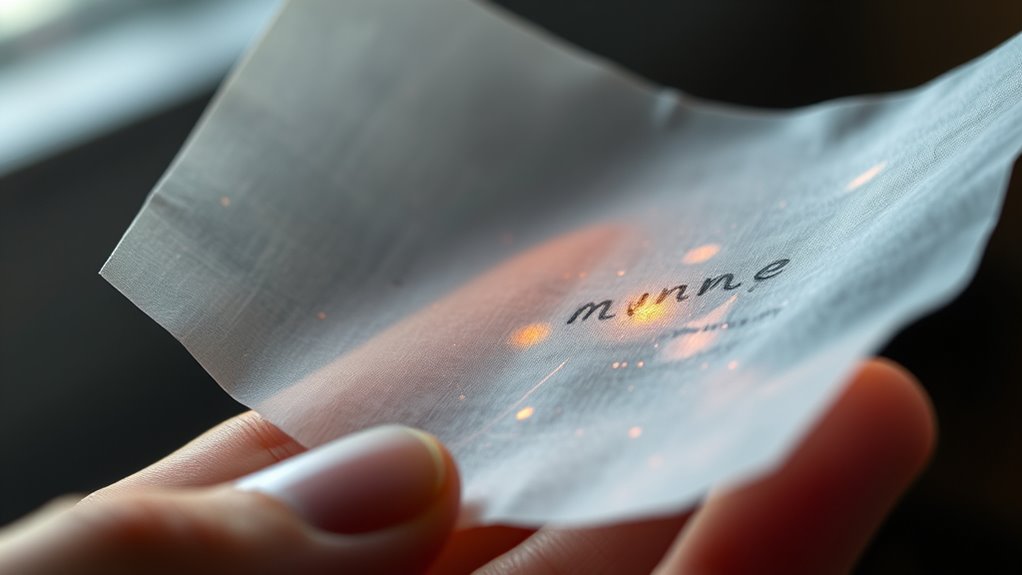
Invisible ink is a special substance that stays hidden or nearly invisible under normal conditions but reveals messages when exposed to certain stimuli. This secret ink can be made from organic compounds like lemon juice, milk, or vinegar.
When you apply it to a surface and let it dry, it remains hidden until you activate it. To see the message, you might shine UV light or use heat or chemicals.
UV light is often used to detect invisible ink because it makes the secret message glow or become visible. This technique has been used historically for covert communication, espionage, and secure messaging.
The ink’s ability to hide messages until the right stimulus is applied makes it a valuable tool for secret exchanges and covert operations.
How Is Invisible Ink Used in Modern Security and Authentication?
Modern security systems use invisible ink to authenticate valuable items and documents effectively. They verify authenticity by revealing complex signatures under specific light conditions, like UV or infrared.
This layered approach allows for quick, non-destructive verification, which improves supply chain security. Advanced optical inks from Sandia produce dynamic signatures that are hard to copy, boosting anti-counterfeit measures.
These invisible security features are integrated into packaging, labels, or directly onto products. This makes them covert but reliable, helping to prevent fraud.
The table below highlights different detection methods used for verification:
| Method | Detection Tool | Application |
|---|---|---|
| UV light | UV scanner | Currency, official documents |
| Infrared | IR camera | High-value products |
| Heat | Thermal imaging | Tamper-evident seals |
| Visible | Special viewing glasses | Authenticity markers |
| Multispectral | Combined detectors | Multi-layer verification |
What Materials Are Used in Today’s Invisible and Security Inks?
Today’s invisible and security inks use a variety of materials, including metallic compounds, organic dyes, and nanomaterials that stay transparent under normal light.
These substances often respond to specific wavelengths like UV or infrared, revealing hidden signatures when illuminated properly.
Advanced options also include heat-sensitive compounds and nanotechnology to create complex, hard-to-copy patterns.
Common Ink Components
Common ink components are designed to create secure and covert markings. Manufacturers use specialized materials like microencapsulated dyes, fluorescent compounds, and metal-organic frameworks that respond to specific stimuli.
Many security inks include taggants—tiny particles embedded to enable authentication under UV, infrared, or near-infrared light. Photoluminescent materials such as rare-earth elements produce complex signatures visible only under certain wavelengths.
Invisible inks often contain organic acids like lemon juice or milk. These react when heated or exposed to UV light, revealing hidden markings. All these components work together to ensure the security, stability, and uniqueness of the inks used for authentication and protection.
| Material Type | Function/Use |
|---|---|
| Microencapsulated dyes | React to stimuli, reveal hidden markings |
| Fluorescent compounds | Enable detection under UV light |
| Metal-organic frameworks | Respond to specific wavelengths, boost security |
| Photoluminescent materials | Produce visible signatures under certain light conditions |
Advanced Taggant Materials
Advances in ink security depend heavily on microscopic taggants made from specialized materials that are nearly invisible under normal conditions. These include tiny particles made of silica, ceramics, or metal-organic frameworks (MOFs), engineered at the nanoscale.
MOFs are crystalline structures that can be customized to emit specific photoluminescent signatures when exposed to UV or infrared light, making them perfect for authentication. Some security inks also incorporate microscopic particles of rare-earth metals or quantum dots.
These materials offer stable emission spectra that are hard to forge. They are designed to stay transparent or nearly invisible under regular lighting but reveal complex, unique patterns when stimulated.
This ensures high security and tamper resistance in modern invisible inks.
Light-Responsive Substances
Modern light-responsive inks use special compounds that react to specific ultraviolet or infrared light wavelengths, revealing hidden messages or patterns.
These inks often contain fluorescent or photoluminescent materials that glow when exposed to certain light sources, making security features easy to spot.
Some inks employ metal-organic frameworks with precisely arranged atoms to emit specific colors under targeted illumination.
Infrared-sensitive inks include microtaggants detectable only with specialized IR equipment, adding an extra security layer.
Photoluminescent substances can produce static or animated signatures that change appearance under different lighting conditions.
These materials are designed to be durable and resistant to environmental factors, ensuring the security features stay effective over time.
How Do Security Inks Differ From Traditional Invisible Inks?
Security inks differ from traditional invisible inks mainly because they are more complex and have advanced detection methods. They often use cutting-edge compositions like nanotechnology, which makes them much harder to copy.
These inks can reveal features under different stimuli such as UV light, infrared, or chemical tests. Unlike basic invisible inks, security inks can also display dynamic or animated signatures, making authentication stronger and more reliable.
Visibility Under Conditions
Have you ever wondered how security inks stand out from traditional invisible inks? Traditional invisible inks only become visible under specific stimuli like heat or UV light.
In contrast, security inks create complex, multi-layered signatures that can change or animate under different lighting conditions, making them much harder to counterfeit. They’re designed to be visible only with specialized detection equipment, not just chemical reactions.
High-tech security inks can reveal dynamic signatures that shift with different light wavelengths, such as UV light, enhancing security features. Some also include microscopic taggants or nanomaterials for extra layers of authentication.
| Feature | Traditional Invisible Ink | Security Ink |
|---|---|---|
| Visibility Conditions | Heat or UV light | Multi-layered, dynamic signatures |
| Detection Method | Chemical reactions | Specialized equipment, UV light |
| Authentication Layers | Basic chemical reaction | Nanomaterials, complex encoding |
Composition and Complexity
Unlike traditional invisible inks that rely on simple chemical reactions to show up, security inks are much more complex. They use specialized compounds and structural designs to create detailed signatures.
Their composition often includes microscopic taggants or advanced metal-organic frameworks. These elements make signatures precise and long-lasting.
Security inks can have multi-layered features, like morphing or animated signatures. They’re designed to be detectable under different light sources, making them more versatile.
They respond to narrow wavelength ranges of UV or infrared light, which boosts security. This complexity allows for multi-factor authentication, combining static and dynamic features.
The microscopic arrangement of components creates signatures that are hard to copy and highly customizable. This elevates the integrity of security features far beyond simple chemical reactions.
Security Features
While traditional invisible inks rely solely on chemical reactions to hide messages, security inks include advanced features that make counterfeiting or tampering much harder. They contain micro-particles or taggants that react differently under specific detection methods like UV or infrared light, making verification easier.
Unlike basic invisible inks, security inks often have multi-layered signatures that change or animate when stimulated, adding an extra layer of authenticity. They’re also designed to be durable, resisting washing or chemical exposure to ensure long-lasting protection.
Many security inks now integrate with digital verification systems, using microscopic components for multi-factor authentication. This mix of advanced techniques makes security inks a vital tool for preventing forgery and keeping sensitive documents secure.
How Are Security Inks Detected and Verified?
Detecting and verifying security inks involves shining specific light wavelengths, like ultraviolet (UV) or infrared (IR), onto the surface. This process reveals hidden signatures embedded within the inks.
Specialized equipment illuminates the ink with UV or IR light, causing the taggants or signatures to fluoresce or change color, which confirms their presence. These signatures can be static or dynamic, sometimes changing under certain conditions to verify authenticity.
Verification also includes measuring how long photoluminescent signatures glow using short UV laser pulses. This helps ensure they match known patterns. Some security inks need multiple detection methods or different light conditions for full authentication.
This layered approach makes counterfeiting more difficult and strengthens security overall.
What Are the Latest Innovations Shaping Invisible Ink Technology?
Recent innovations in invisible ink technology are pushing the boundaries of security and durability.
Nanomaterials are now used in inks to improve invisibility and resilience under harsh conditions, making security features more reliable.
Nanomaterials enhance invisible ink’s durability and security, ensuring reliable protection even in demanding environments.
Researchers are integrating light-sensitive and thermochromic compounds to create security signatures that change or animate in response to specific stimuli, which enhances anti-counterfeiting measures.
Advances in atomic precision within metal-organic frameworks enable the encoding of complex, customizable security signatures with extended longevity, making them harder to replicate.
Digital printing methods, like inkjet, allow for rapid and highly customizable security markers tailored to individual needs.
Moreover, emerging multi-spectral detection techniques improve verification accuracy, enabling authentication under ultraviolet, infrared, and visible light, further advancing the sophistication of invisible ink security systems.
Frequently Asked Questions
How Long Will Invisible Ink Last?
Invisible ink can last anywhere from several months to years, depending on its chemical makeup and storage conditions.
If you use stable substances like milk or lemon juice and keep the message in a dry, dark place, it could stay visible for years. Proper sealing or protective coatings can make it last even longer.
Thanks to advances in formulations, some invisible inks now last for decades when stored under ideal conditions.
Is Invisible Ink Just Lemon Juice?
No, invisible ink isn’t just lemon juice. While lemon juice is popular because it’s inexpensive and easy to use, other substances like baking soda, vinegar, or special chemical dyes also serve as invisible inks.
These different materials react differently under specific conditions, such as heat or chemicals, revealing hidden messages. So, although lemon juice is common, many types of invisible ink exist, each with its own unique properties.
Is Invisible Ink Still Used Today?
Yes, invisible ink is still used today. You might not see it, but it’s behind many security measures like currency, passports, and official documents. Modern inks use advanced nanomaterials and light-sensitive compounds, making them more secure.
Law enforcement also relies on invisible ink to discreetly mark evidence. Furthermore, brands embed hidden marks on luxury items, and digital steganography now hides data within images and files for covert communication.
What’s the Point of Sending With Invisible Ink?
You send messages with invisible ink to keep your communication secret and secure. It helps you transmit sensitive information discreetly, making it hard for outsiders to see or read your message.
This method is especially handy in espionage, military operations, or confidential negotiations. With invisible ink, only the intended recipients can reveal the message.
It’s a great way to maintain privacy and protect your information from interception or unauthorized access.
Conclusion
Invisible ink technology is like a secret language, quietly safeguarding your most valuable information. As you explore its hidden depths, you’ll see how modern security inks act as vigilant guardians, blending science with everyday life.
Innovations keep evolving, turning these invisible messages into powerful tools of protection. This quiet revolution ensures your secrets stay safe and secure.
Adopt this silent form of security, knowing that behind every covert mark lies a fortress of innovation. Invisible ink technology keeps your secrets safe, much like a lock keeps a treasure secure.