What’s the Difference: Toner vs. Ink?
Are you tired of choosing the wrong supplies for your printing needs? You’re not alone—many people struggle to understand the differences between toner and ink, which can lead to costly mistakes. Knowing which one suits your printer and projects can make a big difference in quality and longevity.
Toner is a dry powder used in laser printers that fuses onto paper with heat, making your prints durable and water-resistant.
Ink is a liquid used in inkjet printers, which absorbs into paper and produces vibrant images but may fade faster.
Toner offers sharper text and higher volume output, while ink is better for detailed photos.
If you want to investigate more about these differences, you’ll find useful details ahead.
Key Takeaways
- Toner is a dry powder that gets fused with heat during laser printing, while ink is a liquid sprayed in droplets for inkjet printing.
- Toner gives you sharper text and is more durable. On the other hand, ink offers vibrant colors and high-resolution images.
- Laser printers with toner are perfect if you need to print a lot. Inkjet printers are better suited for photos and detailed graphics.
- Toner cartridges tend to last longer and have a lower cost per page compared to ink cartridges.
- Prints made with toner are water-resistant and smudge-proof. Ink prints, however, may smudge and fade over time.
What Are Printer Toner and Ink?
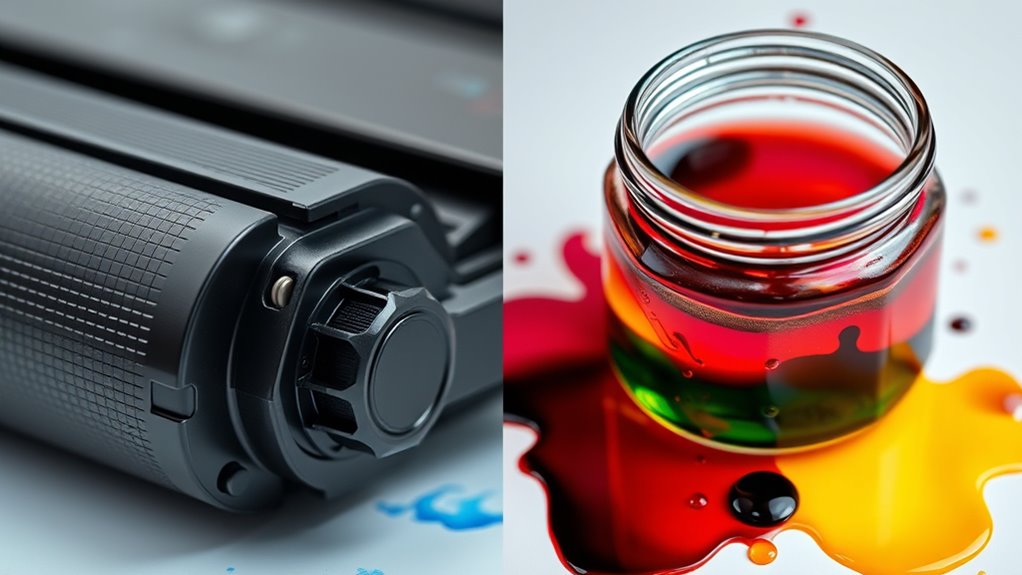
Have you ever wondered what exactly makes up printer toner and ink? Printer toner is a dry powder made of tiny plastic particles, used in laser printers and photocopiers. It’s fused onto paper with heat, creating durable, smudge-resistant prints.
Ink, on the other hand, is a liquid containing dye or pigment, used in inkjet printers for vibrant colors and detailed images. Toner cartridges usually last longer and produce more pages compared to ink cartridges.
While toner delivers crisp, professional-quality output, ink provides rich color variation but can clog printheads and dries faster. Ink’s shelf life is about 18 months, while toner stays stable over time.
Understanding these differences can help you pick the right cartridge for your printing needs.
How Do Printing Processes Differ for Toner and Inkjet?
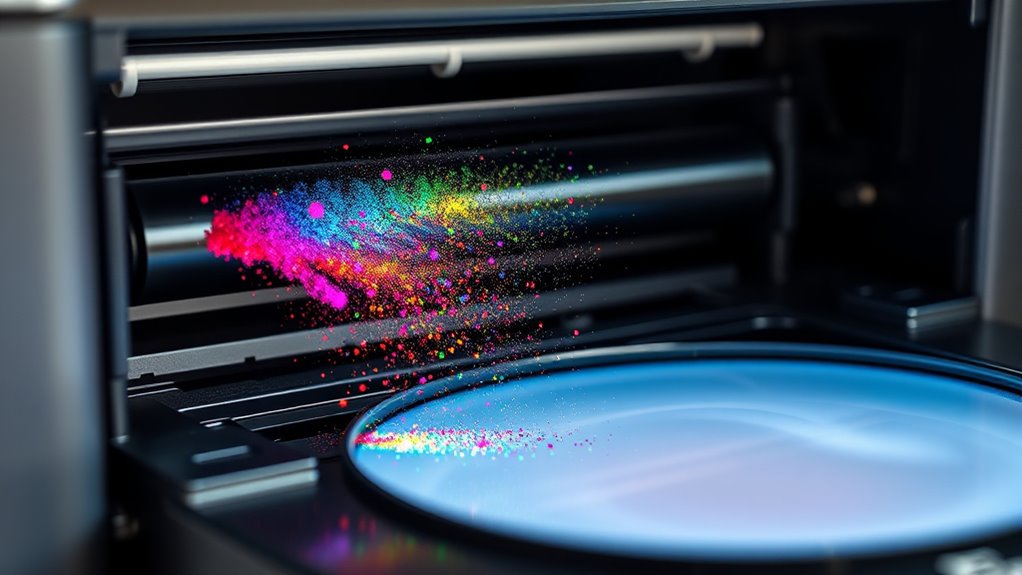
Ever wonder how the printing processes for toner and inkjet differ? Inkjet printers spray tiny droplets of liquid ink through microscopic nozzles onto paper, while toner-based laser printers use a laser to create an electrostatic charge that attracts toner particles.
The printing process varies quite a bit: inkjet printers absorb or dry liquid ink on the paper surface, which can sometimes lead to smudges. In contrast, toner is fused onto paper with heat, making the prints more durable.
You’ll notice that inkjet uses liquid ink directly sprayed onto paper, while laser printers rely on heat to fuse toner onto the surface. Inkjet allows for vibrant colors with precise nozzles, whereas toner creates sharp, water-resistant images.
Which Prints Look Better : Toner or Ink?
Choosing between toner and ink depends not only on cost and durability but also on the quality of the final print.
Selecting between toner and ink hinges on cost, durability, and the desired print quality.
When it comes to print quality, inkjet printers are great at producing high-resolution images with smooth color transitions and accurate hues. They’re perfect for printing photos and detailed graphics, giving vibrant and striking images with lots of depth.
On the other hand, toner-based laser printers usually produce sharper text and cleaner graphics, making documents look more professional. Toner prints tend to be more consistent in both black and color output, with crisp visual clarity.
If you want high-quality photos with rich colors and fine details, inkjet printers are the way to go. For sharp text and graphics with a uniform, polished look, toner printers often deliver better results.
What Are the Cost Differences Between Toner and Ink?
Toner cartridges cost more upfront but last much longer, making them more economical over time, especially for high-volume printing. Ink cartridges are cheaper initially but need frequent replacements, which can drive up your costs.
Considering the long-term expenses, toner often proves more cost-effective despite its higher initial investment.
Initial Purchase Costs
Have you wondered why some printers seem more budget-friendly upfront than others? The initial cost varies quite a bit between inkjet and laser printers.
Inkjet printers usually cost less at the start, often between $50 and $300, making them great for casual use. Laser printers with toner tend to start around $150 to $500 or more because of their advanced tech and larger toner cartridges for high-volume printing.
Save money upfront with affordable inkjet printers. Invest more initially for laser printers with toner cartridges. Feel confident in long-term savings if you need to print a lot.
Cartridge Replacement Expenses
Ever wondered how the ongoing costs differ between toner and ink cartridges? Cartridge replacement expenses play a big role in your overall printing costs.
Ink cartridges are cheaper upfront but need frequent replacements, especially with moderate to high printing volume. This leads to higher ongoing expenses.
They typically yield around 200-300 pages, which results in a higher cost per page—often 10 cents or more.
Toner cartridges, on the other hand, have a higher initial price but can print over 2,000 pages. High-yield toner cartridges further lower the cost per page.
Long-Term Ownership Costs
When comparing long-term ownership costs, toner cartridges are usually more economical than ink cartridges, especially for high-volume printing. With a higher page yield—over 2,000 pages per cartridge—toner lowers the cost per page to around 3 to 5 cents, which helps cut printing expenses over time.
Ink cartridges, on the other hand, cost less upfront but typically only print 200-300 pages. This means you’ll need to replace them more often, leading to higher overall costs. As page coverage increases, ink costs can skyrocket, making toner the smarter choice for consistent, high-volume printing.
Plus, toner cartridges last longer on the shelf, reducing waste and replacement costs. They help you save money with fewer replacements and ongoing printing expenses.
Handling high-volume tasks becomes easier with toner, and you’ll avoid unexpected costs from frequent ink changes. Overall, toner offers reliable, cost-effective printing that saves you money over the long run.
How Long Do Toner and Ink Prints Last?
Toner prints usually last over 20 years, while inkjet prints tend to fade after 5 to 10 years if not stored properly.
The durability depends on factors like material quality and exposure to sunlight or humidity.
Proper storage in a cool, dry, dark place can help both types of prints last longer.
Durability Over Time
Toner prints are known for their durability, often lasting over two decades without significant fading or deterioration. They resist environmental exposure, water, smudging, and highlighter marks, helping them stay vibrant longer.
In contrast, inkjet prints may fade within 1 to 10 years, especially when exposed to sunlight or moisture, particularly with dye-based inks. Your choice impacts how well your prints last over time.
Toner prints keep their color and quality intact longer than inkjet options. Think about these factors:
- Preserve memories with prints that last decades
- Avoid fading in sunlight or humid conditions
- Rely on water-resistant images for durability
- Keep your documents and photos intact over time
- Guarantee consistent print quality regardless of environmental changes
Material Resistance Factors
The longevity of your prints mostly depends on the materials used and how they handle environmental factors. Toner prints are very water-resistant, smudge-proof, and fade-resistant thanks to heat-fused plastic particles, so they can last for decades without much change.
In comparison, inkjet prints, especially those made with dye-based ink, are more prone to fading over time when exposed to light, moisture, and air. Pigment-based inks last longer than dye-based ones and can stay vibrant for several years if stored properly.
Both toner and ink prints are affected by environmental conditions, but toner’s heat-fused technology makes it much more durable in tough environments. The paper you choose and how you store your prints also play crucial roles in keeping them clear and lasting longer.
Proper Storage Practices
Proper storage is essential to ensure your prints stay their best over time. When you store printed materials correctly, you protect them from fading, smudging, and deterioration.
Keep documents away from direct sunlight, high humidity, and extreme temperatures. This helps preserve their durability and keeps colors vibrant. Laser-printed materials are less prone to damage, so they tend to last longer when stored properly.
Inkjet prints, especially on glossy paper, need a bit more care. Using a protective spray or framing can help keep them looking great for years.
Think about the emotional impact of good storage—preserving memories that tell your story for decades, maintaining vibrant colors that brighten your space, and avoiding frustration caused by fading or smudging.
Proper storage also protects your investment in printed materials and gives you peace of mind knowing your prints will last.
Which Printers Are Best for High-Volume or Business Use?
For high-volume or business printing, laser printers with toner cartridges are usually the best choice. They’re great at handling large workloads, with some models printing over 10,000 pages per toner.
Laser printers are fast, reaching speeds of up to 55 pages per minute, which helps keep up with busy environments. Their toner cartridges offer higher yields and longer lifespans, so you don’t need to replace them as often.
This means lower long-term costs and less downtime. Plus, they’re more durable and produce water-resistant, smudge-proof prints — perfect for professional documents.
What Factors Should You Consider When Choosing a Printer?
Choosing the right printer depends on several key factors that match your specific needs. First, think about your printing volume. Laser printers with toner are more cost-effective for high-volume jobs, while inkjet printers are better for low-volume, color-rich tasks.
Next, evaluate document types. Laser printers excel at sharp black-and-white text, whereas inkjets are great for high-quality photos and color graphics. Be mindful of your initial costs and ongoing supplies. Laser printers tend to have higher upfront costs but lower cost per page.
Also, consider space constraints. Inkjet models are usually smaller and perfect for home use. Lastly, determine your need for print durability and water resistance. These qualities are often better in toner-based laser printing.
How Can You Maintain Your Printer for Long-Lasting Performance?
Maintaining your printer regularly is key to making sure it works well over time. Simple tasks like cleaning the printhead and toner cartridge area help prevent clogs and keep your print quality high.
Use only manufacturer-recommended cartridges and replace them as soon as performance drops or warnings pop up. Keep some spare cartridges ready so you’re not caught off guard during busy times.
Storing ink cartridges and toner properly is also important. Keep them in a cool, dry place to avoid drying out or breaking down. Routine cleaning of rollers and fusers, following your printer’s manual, can also help extend its lifespan.
Frequently Asked Questions
What Is Better, Toner or Ink?
Toner is better if you need sharp, durable prints for high-volume or professional use. It’s faster, cost-effective over time, and produces crisp text and images.
Ink is ideal if you want vibrant colors and detailed graphics, especially for photos. But keep in mind, it needs frequent replacements, which can add up.
How Do I Know if I Need Toner or Ink?
You need toner if you’re printing large volumes of sharp, smudge-resistant text that lasts.
If your prints are vibrant photos or detailed graphics, inkjet cartridges are your go-to.
Think about your printing habits—high volume and durability point to toner, while occasional, color-rich prints lean toward ink.
Consider your budget too. Laser printers with toner cost more upfront but save money long-term for heavy use.
Do You Need Both Ink and Toner?
You likely don’t need both ink and toner unless your printing needs are diverse.
If you mainly print high-quality photos or color images, an inkjet printer is the best choice.
For a lot of fast, high-volume document printing, a laser printer with toner is more suitable.
Most households or offices find it more cost-effective to pick one type based on their main use instead of keeping both.
Is It Cheaper to Print With Ink or Toner?
Printing with toner is cheaper in the long run if you do a lot of printing because of its higher page yield and lower cost per page.
Ink might be cheaper upfront and is great for occasional or photo printing, but it needs to be replaced more often, which can add up over time.
If you print frequently or in high volumes, toner saves you money and means fewer cartridge changes.
Conclusion
So, whether you’re ready to dive into the sleek, high-volume world of toner or prefer the charming quirks of inkjet, keep in mind: your choice is basically a lifelong commitment to either endless reloading or occasional smudges.
Pick wisely because your printer isn’t just a device. It’s the silent partner in your daily battle against blank pages.
Choose the wrong one, and you might find yourself stuck in a never-ending saga of paper jams and missed deadlines—especially if you don’t consider the differences between toner and ink.