What Is the Difference Between Toner Vs Ink?
Many people struggle with choosing the right printing supplies for their needs, whether it’s for home use or a busy office. You’re not alone—understanding the difference between toner and ink can be confusing.
Toner is a dry powder made of plastics, carbon, and colorants, used in laser printers for sharp, durable images with heat. Ink is a liquid containing dyes or pigments, used in inkjet printers for detailed, vibrant prints.
Toner offers long-lasting results and is better for high-volume jobs, while ink provides finer quality for photos and graphics. If you want to understand which suits your needs best, you’ll find useful details ahead.
Key Takeaways
- Ink is a liquid that contains dyes or pigments, while toner is a dry powder made of plastics, carbon, and colorants.
- Inkjet printers spray liquid ink to create detailed images. Laser printers, on the other hand, fuse toner with heat to produce durable prints.
- Ink cartridges usually print fewer pages and can dry out over time. Toner cartridges are designed for high-volume printing and tend to last longer.
- When it comes to long-term costs, laser printing generally proves to be more affordable. Plus, the prints are water-resistant and fade-proof, making them more durable.
- Toner cartridges are also more eco-friendly because they’re reusable and produce less waste compared to disposable ink cartridges.
What Are Printer Ink and Toner Made Of?
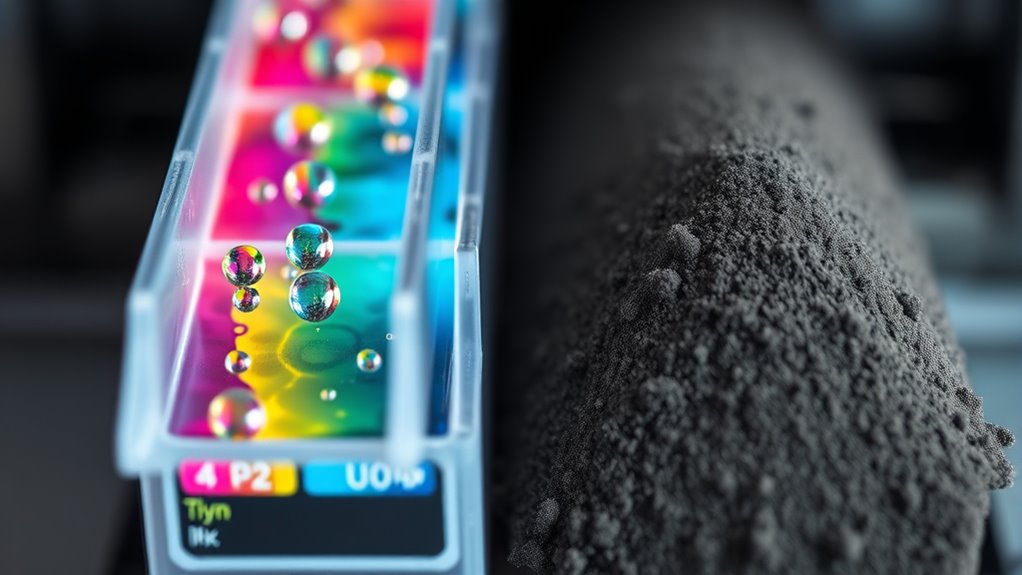
Printer ink and toner are fundamentally different in their compositions. Ink is a liquid made of dyes or pigments suspended in water or oil-based carriers, which helps it flow smoothly through nozzles for precise printing. The chemical makeup of ink guarantees vibrant colors and high-resolution images.
In contrast, toner is a dry powder made of granulated plastics, carbon, and coloring agents. These plastic particles are fused onto paper using heat, creating durable, sharp images. Toner’s dry form makes it perfect for laser printers, where fine plastic particles stick firmly to paper.
While ink relies on liquid flow for application, toner uses heat to melt and bond the plastic particles. Both materials are designed for different printing methods, each with unique chemical and physical properties.
How Do Inkjet and Laser Printers Work?
Understanding how inkjet and laser printers work shows their different ways of producing images and text. Inkjet printers spray tiny ink droplets through microscopic nozzles, creating vivid images.
Thermal inkjet technology heats the ink, forming bubbles that push the ink onto paper. Laser printers, on the other hand, use a laser beam to create an electrostatic charge on a drum.
This charge attracts toner particles, which are fused onto paper with heat. This process results in durable, high-speed printing.
| Printer Type | Printing Process | Key Features |
|---|---|---|
| Inkjet printers | Ink droplets sprayed through microscopic nozzles | Color versatility, photo quality |
| Laser printers | Laser creates electrostatic charge, toner fused onto paper | High speed, volume, durability |
When Should You Use Inkjet or Laser Printers?
Choosing between inkjet and laser printers depends on your specific needs. If you need high-quality photos or detailed graphics, inkjet printers are great because they produce vibrant colors and sharp images.
Inkjet printers excel for vibrant photos and detailed graphics, perfect for high-quality visuals and occasional printing needs.
They’re perfect for occasional use and low to moderate printing volumes, but you’ll need to replace cartridges often and might get fewer pages per cartridge.
Laser printers are better for high-volume printing, especially for text documents. They’re faster and can print more pages before needing a refill.
Although laser printers cost more upfront, they tend to be more cost-effective over time. Think about what you’re printing, how much, and the quality you want to decide which one works best for you.
Cost and Durability of Inkjet vs. Laser Printing
Although laser printers often require a higher upfront investment, they generally prove to be more cost-effective over time because toner cartridges have a lower cost per page and yield thousands of prints.
Toner offers better durability, making laser prints suitable for long-term storage and documents that need to last. They resist water, smudging, and fading.
Inkjet printers, on the other hand, use ink cartridges that typically print fewer pages and tend to dry out or expire if not used regularly, impacting their shelf life and overall cost efficiency.
While inkjet prints may have higher initial quality for photos, laser printers deliver consistent print quality with a lower long-term cost.
For high-volume, durable printing, laser printers and toner cartridges are generally the smarter choice.
Are Ink or Toner Cartridges More Eco-Friendly?
When it comes to environmental impact, toner cartridges generally have the advantage over ink cartridges because they produce less waste and are more reusable. Remanufactured and compatible toner cartridges help with waste reduction and are more eco-friendly by extending their lifespan through refillable options.
They contain fewer plastic components that need frequent replacement, which reduces plastic waste. Manufacturing emissions for toner cartridges are also lower per page compared to ink, making them a more sustainable choice.
Proper recycling programs for toner cartridges help minimize landfill waste and support environmental sustainability. In contrast, ink cartridges often need to be disposed of more frequently, increasing plastic waste and environmental impact.
Which Printer Type Is Best for High-Volume Printing?
Looking to handle large printing jobs efficiently? Laser printers are your best choice for high-volume printing. They come with bigger toner cartridges that can print thousands of pages before needing a replacement, which helps cut down on downtime and costs.
With faster print speeds—up to 55 pages per minute—they’re great at managing big jobs quickly. Their high capacity makes them ideal for professional environments, whether for black and white or color printing.
Laser printers excel at rapid, high-volume printing with speeds up to 55 pages per minute.
The long-lasting toner cartridges give you a higher yield and longer shelf life, so you get consistent output during extended printing sessions. Laser printers produce sharp, durable text that resists water and smudges, making them perfect for demanding tasks.
If you want speed and efficiency, laser printers are the clear choice.
How Do Ink and Toner Affect Print Quality and Color?
Ink and toner greatly influence print quality and color, each excelling in different ways. Inkjet printers produce vibrant, high-resolution colors with detailed nuances, making them perfect for photos and graphics. The color quality depends on the ink cartridges and quality, which can give vivid results but sometimes aren’t as durable.
Toner, used in laser printers, offers sharp, crisp text and graphics with higher resolution and better color accuracy, especially for large print jobs. Prints made with toner are more water-resistant and longer-lasting, making them ideal for high-volume printing.
While ink provides bright, lively colors, it can smudge or fade over time if not dried properly. Toner, on the other hand, ensures consistent color output and reliability, especially in professional documents and busy print environments.
Frequently Asked Questions
Which Is Better, Ink or Toner?
Toner is better if you need fast, high-volume, professional-quality printing for text documents. It offers longer-lasting cartridges and produces sharp, durable output.
Ink is ideal if you want vibrant colors and detailed images, especially for photos or creative projects.
Consider your needs: for business and large-volume printing, toner’s cost-effectiveness and speed make it the better choice. For color-rich, detailed visuals, ink is preferable.
Do You Need Both Ink and Toner?
Do you need both ink and toner? Usually, no. If you mostly print high-quality photos or color graphics, inkjet printers with ink cartridges are your best option.
For quick, high-volume text printing, laser printers with toner are more efficient. Unless your work needs both great images and fast document output, having both isn’t necessary.
Most households and small offices find that one type works perfectly for their needs.
Is It Cheaper to Print With Ink or Toner?
Printing with toner is generally cheaper than ink, especially if you print a lot.
Toner cartridges have a higher initial cost but last much longer, providing thousands of pages at a low cost per page—around 3 cents.
Ink cartridges cost less upfront but need frequent replacements, making them more expensive over time for high-volume printing.
Is Toner Used Instead of Ink?
Yes, toner is used instead of ink, but only in laser printers and photocopiers. It’s a dry powder fused onto paper with heat, not liquid.
So, if you’re thinking of using toner in an inkjet, you’d be out of luck. It’s designed specifically for laser tech, offering faster speeds and higher page yields.
Irony? It’s the perfect choice for those who want durability and volume, not the flexibility of inkjet printing.
Conclusion
Choosing between ink and toner depends on your printing needs. Did you know that laser printers can print up to 20 pages per minute, making them perfect for high-volume tasks?
If you print frequently, toner offers durability and cost efficiency. For occasional, vibrant color prints, inkjet printers might be a better choice.
Understanding these differences helps you make smarter choices, saving money and ensuring your prints look great every time. When deciding between toner vs ink, consider your printing habits to pick the best option for your needs.